Description
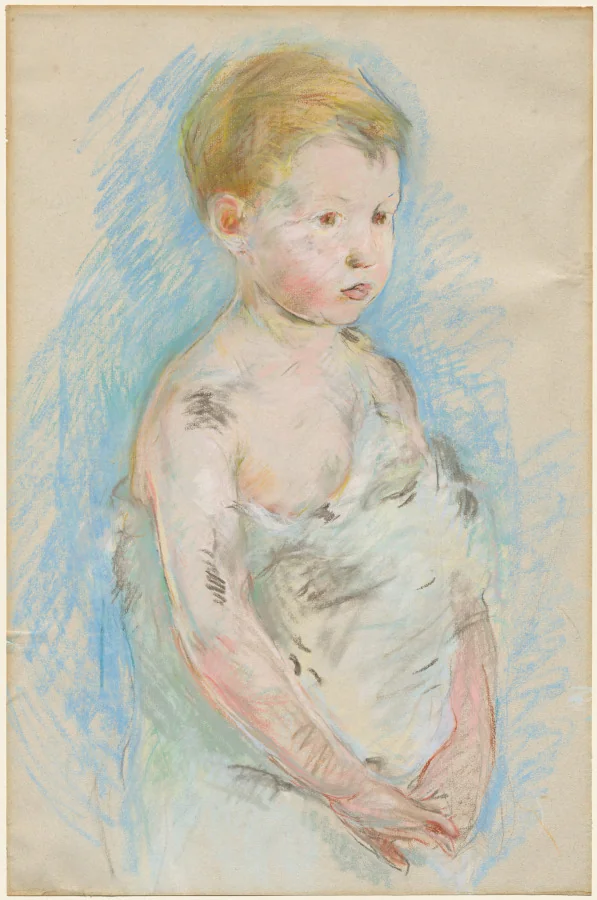
In the spring of 1890 Berthe Morisot and her husband, Eugène Manet, rented a house with a garden overlooking the Seine River in the rural French town of Mézy. Morisot worked in the attic studio while the pair was there. A young boy from the village served as the model for this pastel, one of several studies for a full-length painting of Saint John the Baptist with his cross. In this drawing, Morisot developed the loose and sketchy marks that would characterize her final canvas.
Provenance
Mr. [1874–1942] and Mrs. [1878–1966] Ernest Rouart, Paris (after 1896); (Durand-Ruel, Paris) (1896); Private collection (1896-by 1929); Mr. [1880–1966] and Mrs. [1879–1980] Lewis B. Williams, Cleveland, OH, given to the Cleveland Museum of Art, Cleveland, OH (by 1929-1975); Cleveland Museum of Art, Cleveland, OH (1975-)
Accession Number
1975.83
Medium
pastel on pale blue laid paper
Dimensions
57.1 x 38.1 cm (22 1/2 x 15 in.)
Classification
Drawing
Credit Line
Gift of Mrs. Lewis B. Williams
Tags
Drawing Impressionist & Modern (1851–1900) Pastel Paper French
Background & Context
Background Story
Young Saint John from 1890 is a pastel depiction of a child in the role of Saint John the Baptist, demonstrating Morisot's ability to combine religious subject matter with the intimate, domestic scale that characterizes her work. The pale blue laid paper provides the same luminous base tone as in her other pastels, and the pastel medium allows her to capture the child's features with the rapidity and tenderness that distinguish her depictions of children from the more formal approaches of her contemporaries. The 1890 date places this in the last years of Morisot's career, when her pastel technique had achieved its greatest freedom and luminosity.
Cultural Impact
Morisot's religious subjects are rare and always treated with the intimacy and domesticity that distinguish her work from the more formal religious paintings of her contemporaries. Young Saint John is not a grand altarpiece but a pastel on paper—a domestic-scale image that treats the religious subject with the same tenderness and immediacy that Morisot brought to her portraits of family members and household servants.
Why It Matters
Young Saint John is Morisot treating a religious subject with domestic intimacy: a child as Saint John, rendered in pastel on pale blue paper with the tenderness that characterizes her portraits of children. The religious subject is not grand but intimate—not an altarpiece but a pastel, the sacred made personal in the medium that women Impressionists made their own.