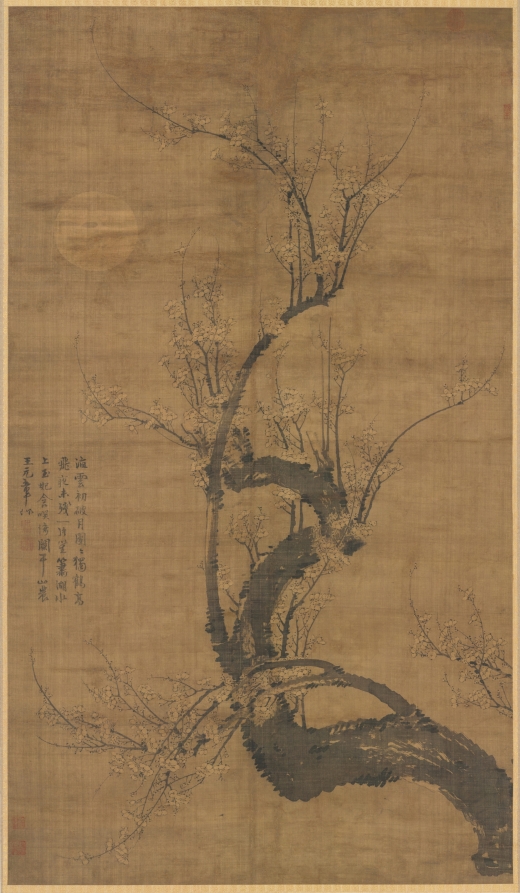
Description
The plum flourishes in the mild climate of the south, and it was not before the Six Dynasties period (220– 589 CE) that the motif began to be appreciated by southern artists, many of whom had emigrated from the north.
Wang Mian from Zhejiang province had failed the civil and military service examinations and later rejected appointments under the Mongol government. Instead, he chose to return home, making a living by selling plum paintings. Few of Wang’s works have survived, but they demonstrate that by his time the ink-plum (momei) genre was fully developed.
Wang Mian from Zhejiang province had failed the civil and military service examinations and later rejected appointments under the Mongol government. Instead, he chose to return home, making a living by selling plum paintings. Few of Wang’s works have survived, but they demonstrate that by his time the ink-plum (momei) genre was fully developed.
Provenance
Qing imperial collection, seals of the Qianlong Emperor, reigned 1736–95; Dong Gao 董誥 [1740–1818]; Marquis Asano Nagakoto 侯爵 淺野長勲 [1842–1937], Hiroshima, Japan; Yasuda Family 安田家, chief retainer of the Asano Family; (Mayuyama & Co., Ltd., Tokyo, Japan, sold to the Cleveland Museum of Art) (?–1974); The Cleveland Museum of Art, Cleveland, OH (1974–)
Accession Number
1974.26
Medium
Hanging scroll; ink on silk
Dimensions
Painting: 164.6 x 94.6 cm (64 13/16 x 37 1/4 in.); Overall with knobs: 260.6 x 126.3 cm (102 5/8 x 49 3/4 in.)
Classification
Painting
Credit Line
Leonard C. Hanna Jr. Fund
![Saint Bernard and Saint Catherine of Alexandria with the Virgin of the Annunciation [right panel]](https://api.nga.gov/iiif/e6890364-4d99-4684-a62b-5060ee3c3446/full/400,/0/default.jpg)