Description
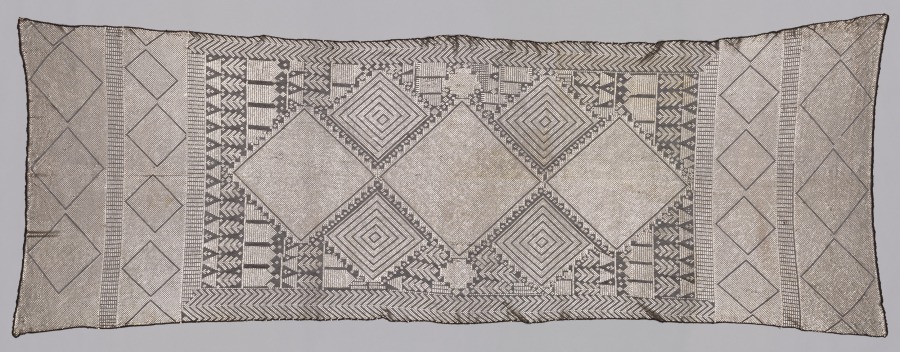
Egyptians may have innovated tulle-bi-telli (“net with metal,” also called assiut) after the French introduced machine-made netted fabric (tulle) in the late 1800s. It drew from telli, an earlier metal embroidery technique. Diamond and rectangle designs formed by knotting flattened silver wire into black tulle indicate this scarf’s early age in the genre. Urban Egyptian singers and dancers performed in heavy, shimmering tulle-bi-telli costumes during the late 1800s through the mid-1900s. Elite Egyptian city dwellers also wore it. Similar ones were sold at the 1893 World’s Columbian Exposition in Chicago and to tourists in Egypt, a possible origin for this example. In the US, tulle-bi-telli scarves were made into home decor and 1920s flapper-style clothing.
Provenance
Mrs. Edward N. Dekker, Sr., gifted to the Cleveland Museum of Art (1974); The Cleveland Museum of Art, Cleveland, OH (1974-)
Accession Number
1974.1058
Medium
Probably cotton and silver-plated copper foil
Dimensions
Overall: 221 x 82.2 cm (87 x 32 3/8 in.)
Classification
Garment
Credit Line
Gift of Mrs. Edward N. Dekker, Sr.