Description
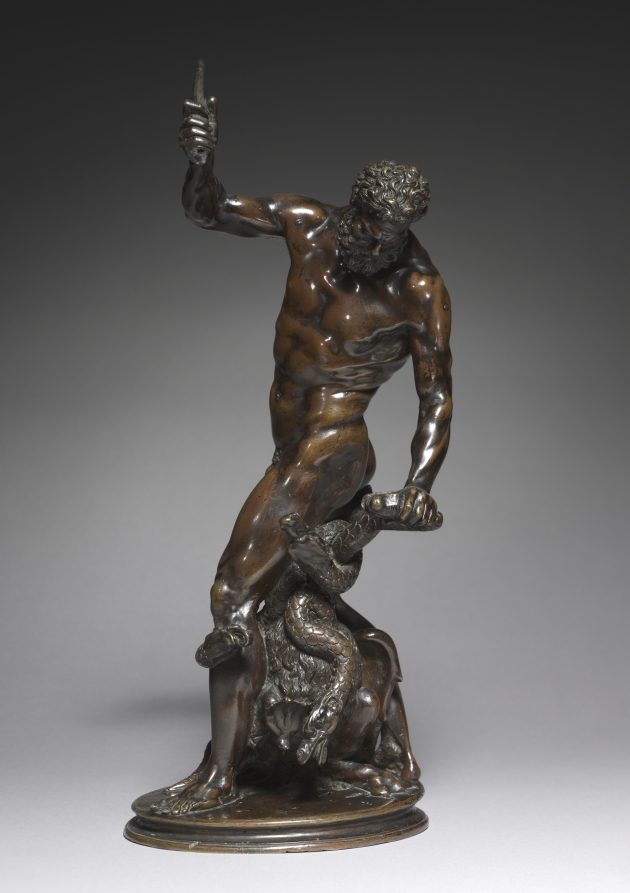
Hercules slayed the Lernean Hydra as the second of the ancient hero’s twelve labors. When one of the nine snake-like heads was destroyed, two grew back. Hercules cauterized each stump, allowing him eventually to kill the monster. The object he holds may have been a club, sword, sickle, or torch. The sinuous, scaly Hydra and the defined musculature presented challenging opportunities for sculptors working in bronze. The raw, tumultuous energy and twisting form-associated with artists of the late 1500s-contrasts to Jacopo Sansovino’s earlier Virgin and Child (1951.316).
Provenance
L. L. Neumann (London, England), 1919;; William Salomon, 1852-1919 (New York, New York), upon his death, held in trust by the estate.; Estate of William Salomon, sold in 1923;; Henry Walters, 1948-1931 (New York, New York), upon his death, by inheritance to his wife, Mrs. Henry Walters;; Mrs. Henry Walters, (New York, New York), 1941;; Mrs. Gaby Salomon (London, England), 1966-1973, sold to the Cleveland Museum of Art, 1973.; Dr. Kaufman;; Dr. Otto Wertheimer (Paris, France);; Herbert N. Bier (London, England)
Accession Number
1973.167
Medium
bronze
Dimensions
Overall: 47.5 x 18 x 18 cm (18 11/16 x 7 1/16 x 7 1/16 in.)
Classification
Sculpture
Credit Line
Purchase from the J. H. Wade Fund