Description
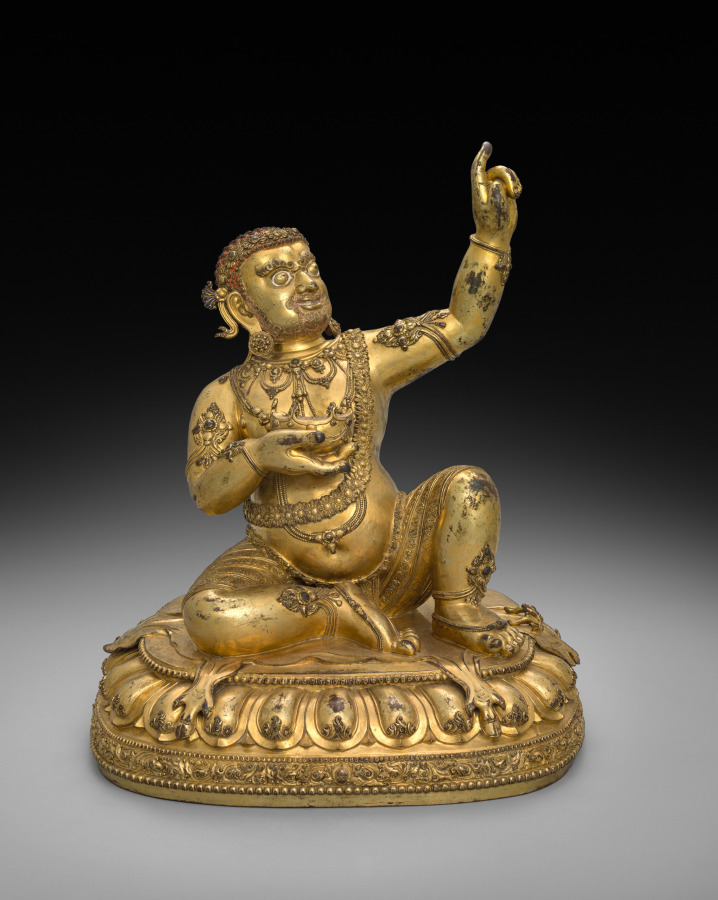
Virupa is one of the great teachers in the history of tantric Buddhism. His posture references his ability to stop the sun; as an enlightened being, he can control phenomena of nature. As a tantric practitioner, he overturns ordinary assumptions about proper behavior, so he overeats, drinks large quantities of liquor, and waits for the king to pay his bill at the tavern.
At the edge of the lotus pedestal is an inscription identifying the image as having been made in the imperial kilns of the third emperor of the Ming dynasty in China as a gift to a Tibetan monastic leader. While closely linked to Tibetan styles, the luxurious detailing, special gilding process, and the casting of the ornaments onto the body without use of inlay are specifically Chinese characteristics.
At the edge of the lotus pedestal is an inscription identifying the image as having been made in the imperial kilns of the third emperor of the Ming dynasty in China as a gift to a Tibetan monastic leader. While closely linked to Tibetan styles, the luxurious detailing, special gilding process, and the casting of the ornaments onto the body without use of inlay are specifically Chinese characteristics.
Provenance
Purchased from an Indian dealer in Kathmandu, Nepal (?–1965); (J. J. Klejman Gallery, New York, NY, sold to the Cleveland Museum of Art) (1965–1972); The Cleveland Museum of Art, Cleveland, OH (1972–)
Accession Number
1972.96
Medium
Gilt bronze with silver, stones, and pigment
Dimensions
Overall: 43.6 cm (17 3/16 in.)
Classification
Sculpture
Credit Line
Gift of Mary B. Lee, C. Bingham Blossom, Dudley S. Blossom III, Laurel B. Kovacik, and Elizabeth B. Blossom, in memory of Elizabeth B. Blossom