Description
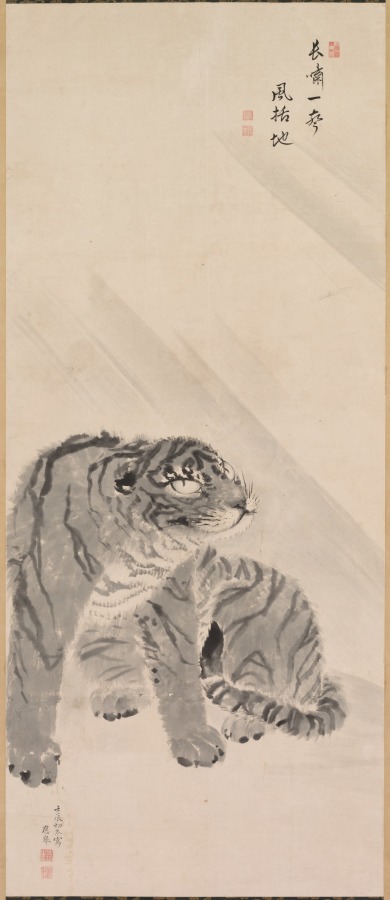
The seals appended to the inscription on this painting suggest that the text was brushed by Yūjō (1723–1773), an imperial prince who became a Buddhist monk and was abbot of Enman'in at Miidera. The line is from a poem attributed to a Yuan dynasty poet, Yu Ruyu (dates unknown), and describes the sound of a fierce wind lashing the ground. Wind is associated with the roar of the tiger. Yūjō was Maruyama Ōkyo's most important patron as a young artist, and this painting has a signature asserting that Ōkyo created it in 1772, the year before Yūjō's death. While Yūjō produced a preface for a now famous set of handscrolls he commissioned Ōkyo to paint, and a number of Ōkyo's compositions for Enman'in survive, this work would appear to be one imagining their relationship, as opposed to a genuine piece.
Provenance
Murado Torujiro, Ōtsu, Japan; (Nisaburo Mizutani, Kyoto, Japan, sold to the Cleveland Museum of Art) (?–1971); The Cleveland Museum of Art, Cleveland, OH (1971–)
Accession Number
1971.232
Medium
hanging scroll; ink on paper
Dimensions
Painting: 134.6 x 58 cm (53 x 22 13/16 in.); Mounted: 194 x 73 cm (76 3/8 x 28 3/4 in.)
Classification
Painting
Credit Line
Sundry Purchase Fund