Description
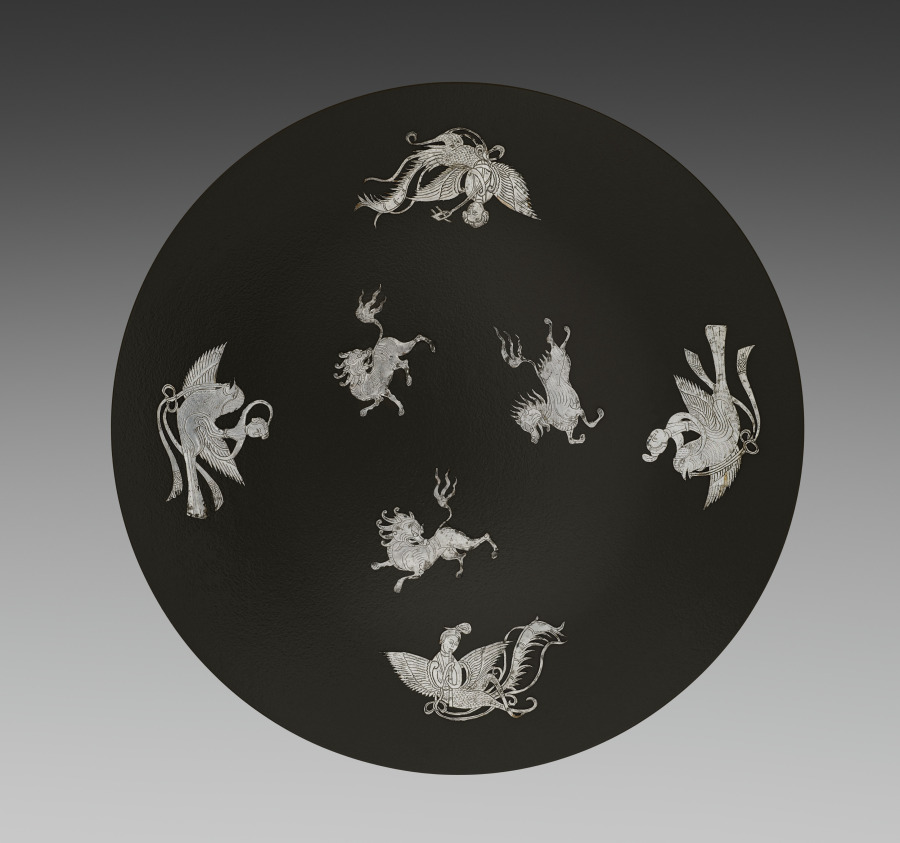
The p'ing-t'o technique of inlaying gold and silver foil on lacquer produced luxurious articles of elegance and fragility. These stray silver inlays were originally mounted on a mirror back or a cosmetic box whose lacquered surface has disintegrated. They combine auspicious symbols of Indian and Chinese origin: human-headed birds whose melodies filled the Buddhist paradise, and bird-riding deities who inhabited the skies of Taoist mythology. Like these imaginary beings, the lions were probably paired in a radial design; at least one has been lost.
Provenance
[]
Accession Number
1969.78
Medium
beaten silver with chased details
Dimensions
Overall: 4.7 x 8.4 cm (1 7/8 x 3 5/16 in.); Irregular: 5.3 x 8.4 cm (2 1/16 x 3 5/16 in.); Part 1: 4.6 x 8.4 cm (1 13/16 x 3 5/16 in.); Part 2: 5.2 x 7.8 cm (2 1/16 x 3 1/16 in.); Part 3: 5.2 x 5.6 cm (2 1/16 x 2 3/16 in.); Part 4: 4.2 x 6.1 cm (1 5/8 x 2 3/8 in.); Part 5: 4.6 x 5.2 cm (1 13/16 x 2 1/16 in.)
Classification
Metalwork
Credit Line
Gift of Eugene Victor Thaw