Description
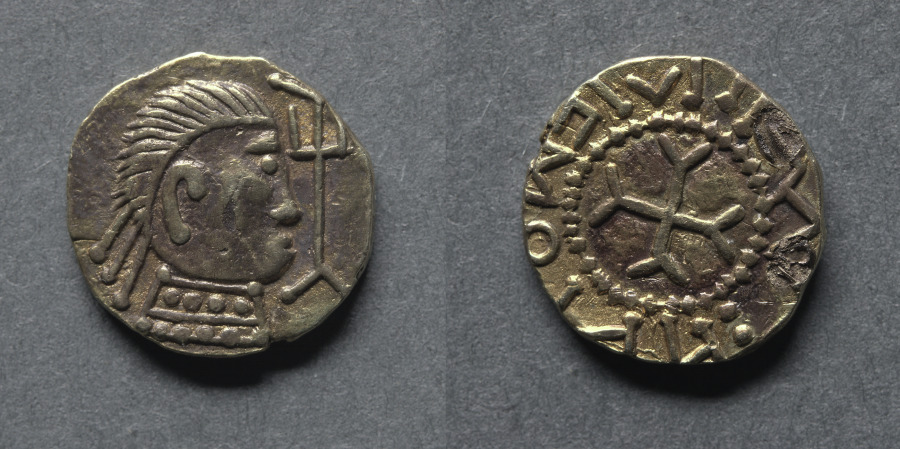
The Crondall Hoard is a hoard of coins that was found in 1828 in the village of Crondall in the English county of Hampshire. It is believed to date to the seventh century and was studied by Dr. Carol Humphrey Vivian Sutherland (1908-1986), an English numismatist. He characterized this coin as being a close copy of the Witmen prototype, the most common type found in the hoard. Witmen, or his design, featuring a bust on one side and a cross on the other, seems to have been very popular and remained popular for many years. During this time however the portraits grew cruder and cruder, the legends became even more blundered, and the gold content fell lower and lower.
Provenance
Mrs. Emery May Holden Norweb (1895-1984), Cleveland, OH, gifted to the Cleveland Museum of Art (-1969); The Cleveland Museum of Art, Cleveland, OH (1969-)
Accession Number
1969.159
Medium
gold
Dimensions
Diameter: 1.1 cm (7/16 in.)
Classification
Coins
Credit Line
The Norweb Collection