Description
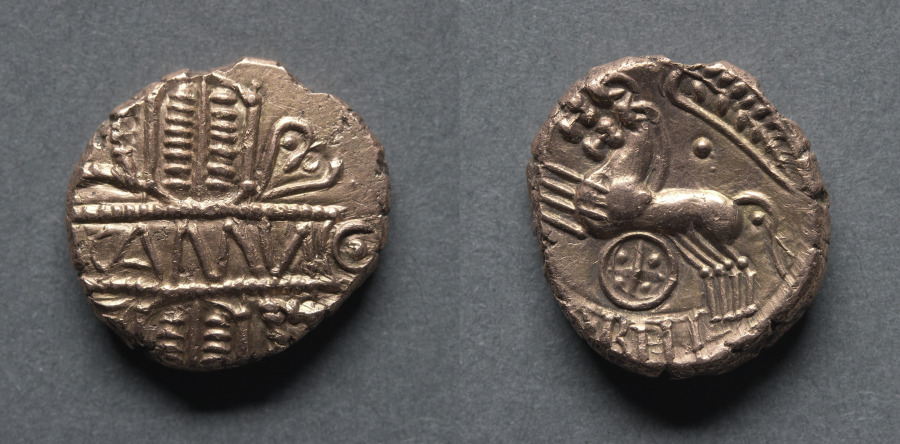
Cunobeline is mentioned by various Roman historians. He was a powerful ruler, the son of Tasciovanus. He is known to have had one brother, Epaticcus, and possibly another, Sego, as well as two sons, Caratacus and Togodumnus. The history of this ancient time is very confused, particularly over family relationships; some of the sons and brothers may well have been sons-in-law and brothers-in-law. Cunobeline had his capital at Camulodunum, now Colchester. The workmanship of this extremely rare piece is remarkable in many ways. Study of the obverse shows that at least one of the V-shaped ornaments referred to by scholars is traditionally described as "heart" shape. In fact it is the little ivy leaf frequently found on Roman coins. The two well-executed, three-dimensional spirited horses on the reverse are unusual. One such animal is normally all the engraver of the period usually attempts. The wheel of the lost chariot is still present and the neat design of a leaf as an ornament is interesting. All this design detail serves to crowd off all but a few letters of the ruler's name. The CAMVL on the obverse makes this one of the earliest British native coins to state its mint town origin.
Provenance
Mrs. Emery May Holden Norweb (1895-1984), Cleveland, OH, gifted to the Cleveland Museum of Art (-1969); The Cleveland Museum of Art, Cleveland, OH (1969-)
Accession Number
1969.152
Medium
gold
Dimensions
Diameter: 1.8 cm (11/16 in.)
Classification
Coins
Credit Line
The Norweb Collection