Description
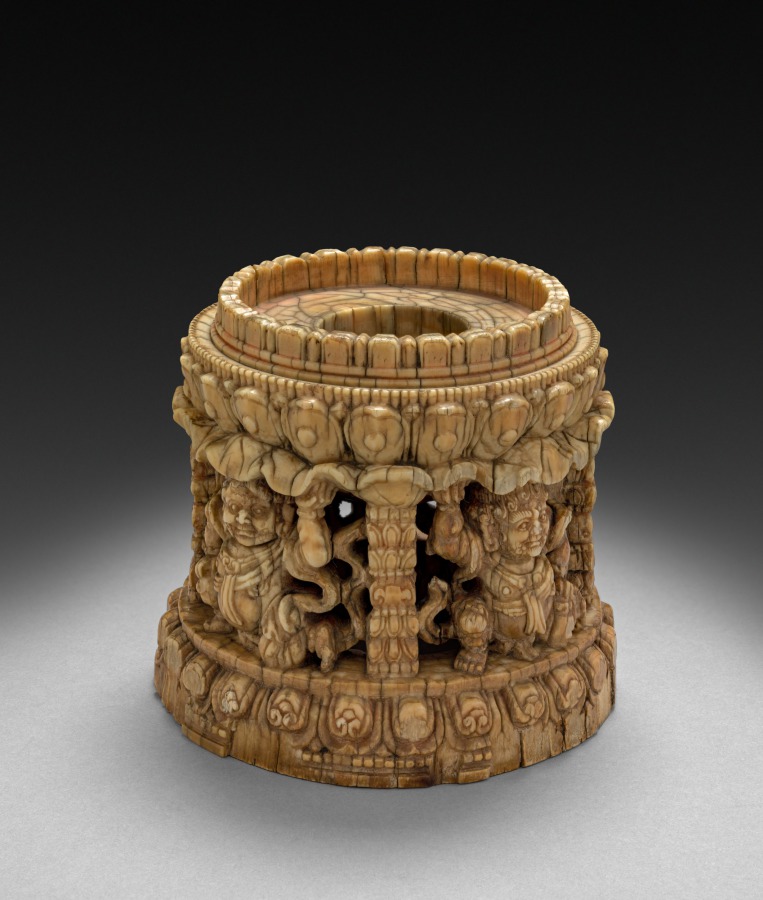
Small circular pedestal or stand for an icon or figure, most probably a Buddha. Starting from the base of the pedestal, there is a band of pearling or beading, a row of everted lotus petals, four dwarf-like creatures alternating with four square columns, a lotus leaf, another row of lotus petals, their stamens and anthers, and finally a row of alternating large and small elements retaining traces of a red stain and probably representing stylized lotus petals. The pedestal is in the form of a well-known type, the double lotus pedestal (visvapadma), which was particularly popular in the second half of the sixth century, being found in most of the Chinese cave sites of that period. This pedestal however, represents a later continuation of the type.
Provenance
(Christie's, London, England); Frederick M. Mayer [1899–1974], New York, NY, given to the Cleveland Museum of Art (?–1968); The Cleveland Museum of Art, Cleveland, OH (1968–)
Accession Number
1968.70
Medium
ivory
Dimensions
Overall: 7.8 cm (3 1/16 in.); Diameter of base: 9 cm (3 9/16 in.)
Classification
Sculpture
Credit Line
Gift of Mr. and Mrs. Frederick M. Mayer