Description
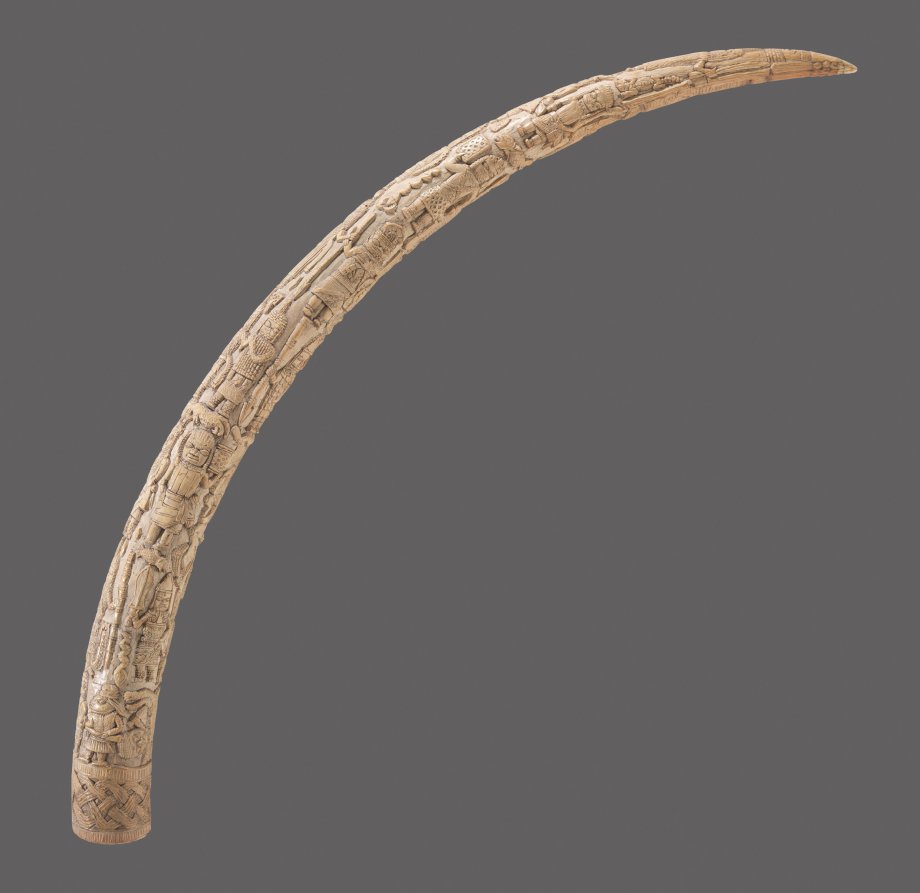
Ọba Ọsẹmwẹdẹ commissioned the carving of this tusk to connect with his ancestors and symbolize his strength. It is covered with royal figures wearing elaborate regalia and scenes of power, ritual, and violence. While Benin royal symbols may look similar across centuries, their meanings can shift. Ọsẹmwẹdẹ’s reign was prosperous due to trade with the Dutch; however, 16th-century Portuguese men are carved on the lower tusk. By the 1800s they represented any European traders. This tusk’s surface likely became worn and cracked from frequent washing, bleaching, and the applying of a white clay (orhue) linked to peace, purity, and prosperity.
Provenance
Commissioned by Ọba Ọsẹmwẹdẹ [r. 1815–50] from the Igbesanmwan (1820s); Ọba Ọsẹmwẹdẹ [r. 1815–50], Royal Palace, Benin City, by descent to Ovọnramwẹn (Ovọnramwẹn Nogbaisi [c. 1857–1914, r. 1888–97] (after 1850); Brought to England (or Europe) following the Siege of Benin (1897); Katherine (Merkel) White Reswick [1929-1980], Gates Mills, OH, given to the Cleveland Museum of Art (by at least 1961–1968); The Cleveland Museum of Art, Cleveland, OH (1968–)
Accession Number
1968.284
Medium
Elephant ivory
Dimensions
Overall: 197.4 cm (77 11/16 in.)
Classification
Sculpture
Credit Line
Gift of Katherine C. White