Description
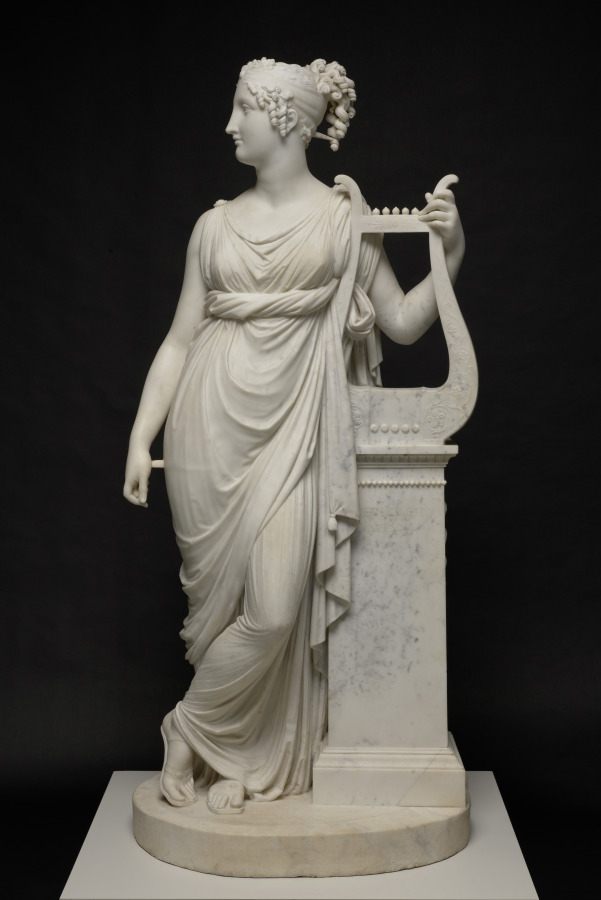
In Greek mythology, Terpsichore was one of the nine Muses, or goddesses of creative inspiration. The lyre, the Greek inscription on the short column, and the caduceus (entwined snakes) on the side identify the figure as Terpsichore Lyran, muse of lyric poetry. This sculpture began with a commission from Napoleon's brother, Lucien, for an idealized portrait of his wife, Alexandrine. Antonio Canova made this version for a British aristocrat and exhibited it in 1817 at the Royal Academy in London to great acclaim.
Provenance
Simon H. Clarke, 9th Bt., 1764-1832 (Oak Hill, East Barnet, England);; Alfred de Rothschild, 1842-1918 (Halton, Buckinghamshire, England), by inheritance to his nephew, Lionel de Rothschild, 1918;; Lionel Nathan de Rothschild, 1882-1942 (Exbury, Hampshire, England), 1918-1942, by inheritance to his first son, Edmund Leopold de Rothschild, 1942;; Edmund Leopold de Rothschild, born 1916 (Exbury, Hampshire, England), sold to Wildenstein & Co., 1963;; Wildenstein & Co. (New York, New York), sold to the Cleveland Museum of Art, 1968.; The Cleveland Museum of Art, Cleveland, OH (1968-)
Accession Number
1968.212
Medium
marble
Dimensions
Overall: 177.5 x 78.1 x 61 cm (69 7/8 x 30 3/4 x 24 in.)
Classification
Sculpture
Credit Line
Leonard C. Hanna Jr. Fund