Description
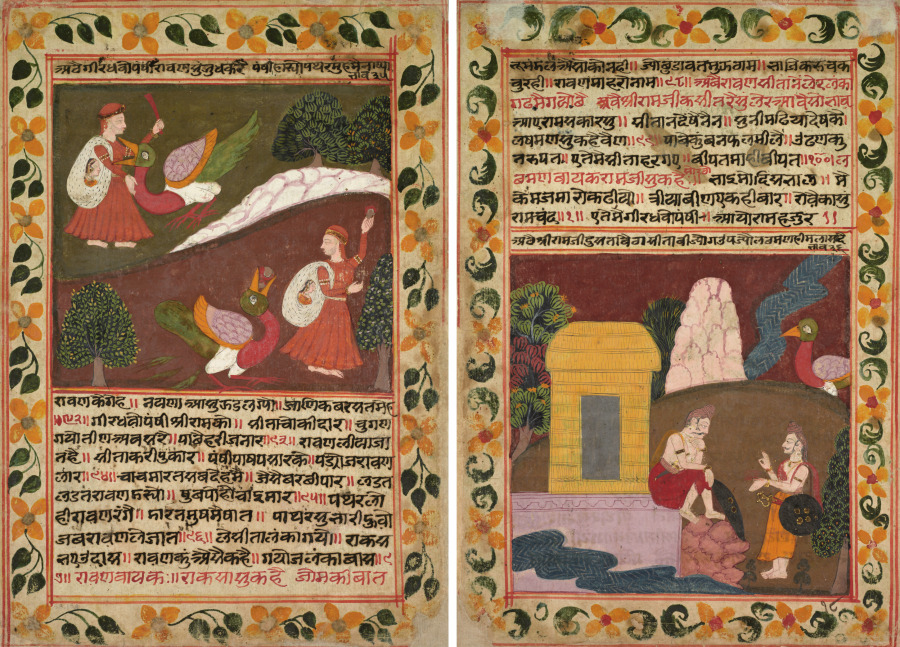
Scenes pertaining to the loss and rescue of Sita have been embedded in a popular tale written by Bhadrasena (active c. 1620), and expanded by the poet Karamacand in 1629–30. The pages from this manuscript are dispersed among many collections. Its last page, known from a photograph provided by Arun Bharany in New Delhi, includes a colophon statement. It informs us that the manuscript was written in Samvat 1802 (equivalent to 1744–45) in Kishangarh for five patrons named Rikhaji, Karamchandji, Mahataji, Shri Jagamalaji, and his son Motichandji. The scribe was a monk named Udayasagar in the Bijai (or Vijay) Gacch, a monastic lineage of the Shvetambar Jains.
Provenance
(Arun Bharany, New Delhi, India, sold to the Cleveland Museum of Art) (?–1968); The Cleveland Museum of Art, Cleveland, OH (1968–)
Folio 18 from a Chandana Malayagiri Varta (Story of King Chandana and Queen Malayagiri) of Karamachand: Ravana battles the great vulture Jatayu and defeats him by throwing stones in his mouth (recto); Jatayu approaches Rama and Lakshmana who are wondering where Sita could be (verso)
1744–45
Accession Number
1968.108
Medium
Gum tempera, ink, and gold on paper
Dimensions
Recto Painting: 13.4 x 14.9 cm (5 1/4 x 5 7/8 in.); Verso Painting: 14.9 x 14.8 cm (5 7/8 x 5 13/16 in.); Overall: 28.8 x 20 cm (11 5/16 x 7 7/8 in.)
Classification
Painting
Credit Line
James Parmelee and Cornelia Blakemore Warner Funds