Description
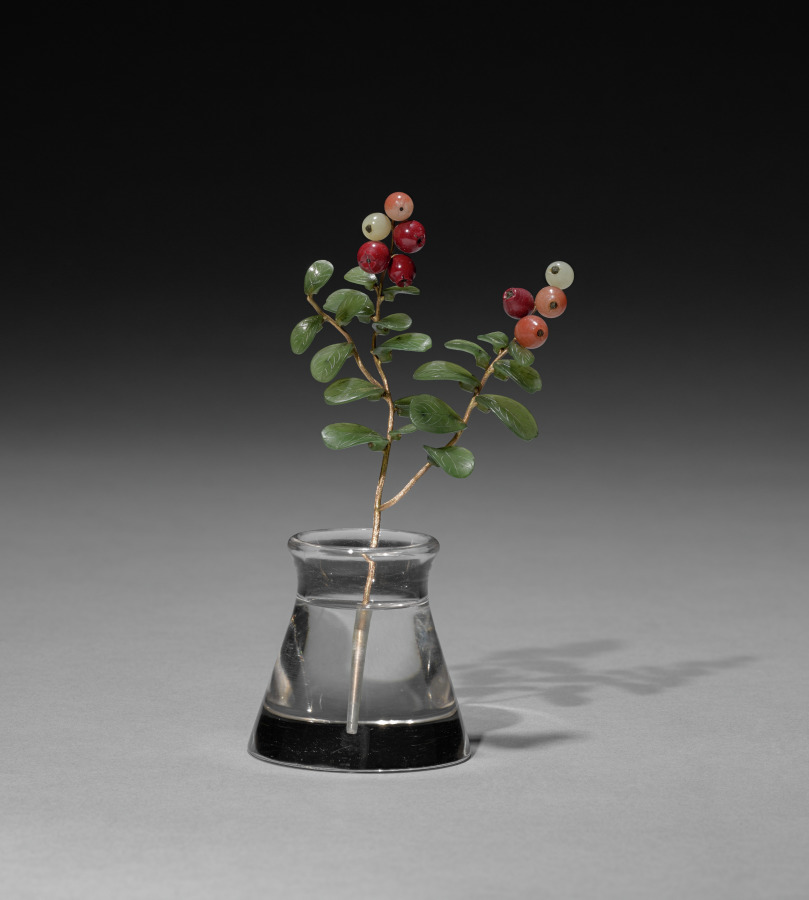
This flower study depicts a lowbush cranberry or lingonberry. To achieve a naturalistic effect of ripening fruit, Fabergé varied the coloring of the berries. Some are made of chalcedony in hues of milky white to represent unripe berries, while others appear in deep reddish agate to represent ripe ones. Fabergé’s inspiration for his flower studies is said to have come from the floral brooches of precious stones that were made in the 1700s for Catherine the Great as well as from the Japanese art of flower arranging, known as ikebana. Fabergé’s flower studies were given as intimate gifts to friends by the tsarina and others in the court. She also liked to take them around to wherever the imperial family was residing as a reminder of spring during the harsh Russian winters.
Provenance
India Early Minshall [1885–1965], Cleveland, OH, bequest to the Cleveland Museum of Art (?-1966); The Cleveland Museum of Art, Cleveland, OH (1966-)
Accession Number
1966.446
Medium
chalcedony, jade, rock crystal, gold
Dimensions
Overall: 11.5 x 4.8 cm (4 1/2 x 1 7/8 in.)
Classification
Miscellaneous
Credit Line
The India Early Minshall Collection