Description
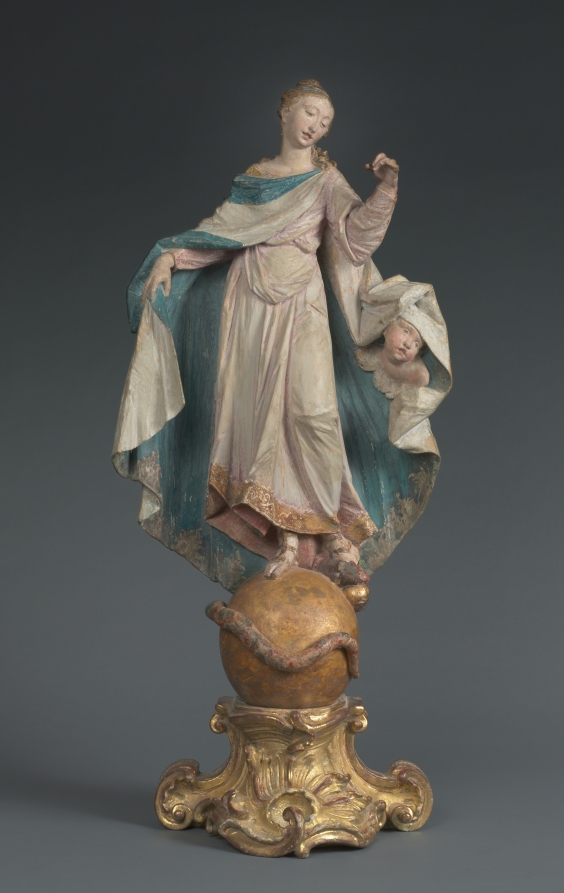
The Christian doctrine of the Immaculate Conception maintains that the Virgin Mary was conceived free from sin, ready to be the pure vessel for Christ’s birth. Depicting such an abstract idea required specific imagery. The moon beneath the Virgin’s feet, for example, comes from the New Testament vision of Saint John the Evangelist (Revelation 12:1) of “a woman clothed with the sun, with the moon under her feet,” while the serpent upon which she treads symbolizes Christ’s triumph over original sin. With his characteristically delicate modeling, elongated proportions, and soft coloring, Ignaz Günther created an archetypal image of innocence on the cusp of womanhood.
Provenance
Private collection, Munich (sold, Weinmüller, Munich, December 5-6, 1962, lot no. 1149, to Kurt Rossacher); Kurt Rossacher (Salzburg, Austria), sold to the Cleveland Museum of Art, 1963.
Accession Number
1963.294
Medium
painted and gilded wood
Dimensions
Overall: 78.6 x 34.5 x 19.2 cm (30 15/16 x 13 9/16 x 7 9/16 in.)
Classification
Sculpture
Credit Line
Leonard C. Hanna Jr. Fund