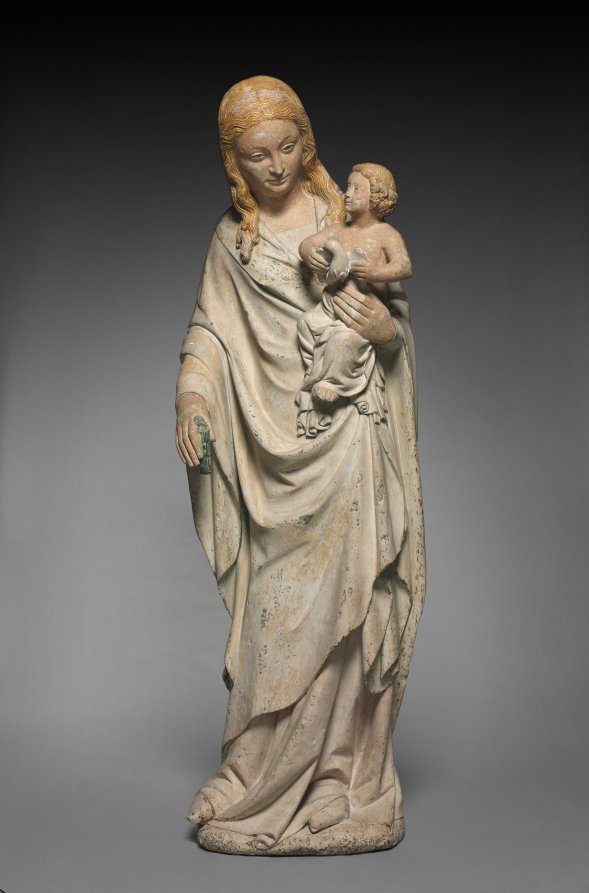
Description
The vibrant naturalism of the Virgin’s face and long flowing hair, as well as the deep, rich folds of drapery are characteristic of the work of itinerant artists from the Netherlands who found employment at the Valois courts of France at Paris, Berry, and Burgundy. Their native styles and attention to realistic detail fused with native French artistic traditions toward the end of the 14th century and took root. The original source of this Virgin and Child is unknown, but its style suggests a relationship with similar sculptures made for churches and abbeys of the Central Loire Valley. The additional influence of the style of the sculptor André Beauneveu has also been noted for this sculpture. His commissions were abundant and his influence widespread. The sculptor of this work appears to have had some knowledge of Beauneveu’s work in the Loire region.
Provenance
(Mrs. Paul Mallon (d. 1977), New York, NY, sold to the Cleveland Museum of Art). (-1962); The Cleveland Museum of Art, Cleveland, OH (1962-)
Accession Number
1962.28
Medium
limestone with traces of polychromy
Dimensions
Overall: 135.3 x 41.3 x 30.5 cm (53 1/4 x 16 1/4 x 12 in.)
Classification
Sculpture
Credit Line
Purchase from the J. H. Wade Fund