Description
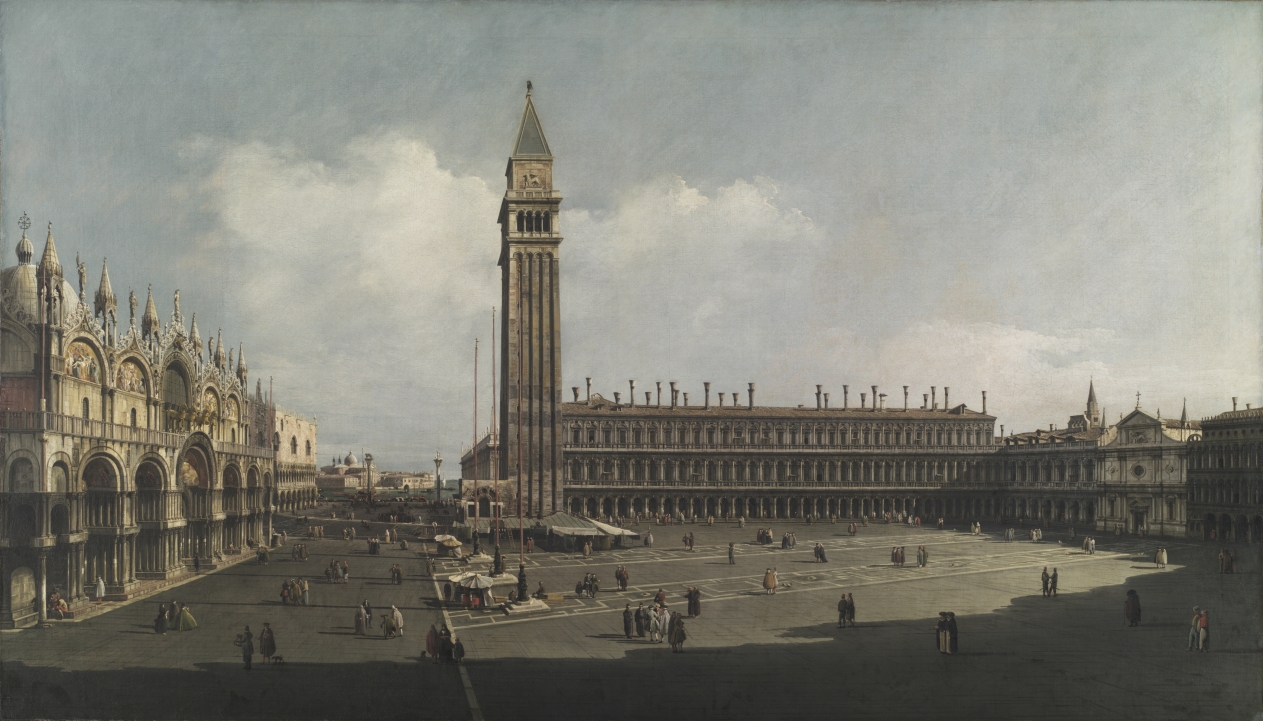
This view of the Piazza San Marco, Venice shows Bellotto's devotion to faithful observation. At the left is the church of St. Mark with the Doge's Palace just beyond, leading to the lagoon. Vertically dividing the canvas is the campanile (bell tower) with the Procuratie Nuove (a government building) extending to the right. At the extreme right, opposite St. Mark's, is the façade of the church of San Geminiano which was removed in the 19th century by Napoleon. The two wings of the Procuratie were then joined across the west end of the piazza. Bernardo Bellotto was the nephew and student of Canaletto (Giovanni Antonio Canal, 1697–1768) who ran one of the most productive painting workshops in Italy. Like his uncle, Bellotto specialized in vedute (views) of Italy, especially Venice, which were purchased avidly by British aristocrats traveling on the Grand Tour. Bellotto later worked for the courts of Dresden, Vienna, Warsaw, and Munich, painting topographical and imaginary views of those cities.
Provenance
William, 2nd Earl of Craven [1809-1866], Combe Abbey, Warwickshire (by 1833); George Grimstone Craven, 3rd Earl of Craven [1841-1883], Combe Abbey, Warwickshire (1866-1883); William George Robert, 4th Earl of Craven [1868-1921], Combe Abbey, Warwickshire (1883-1921); Cornelia (nee Martin), Countess of Craven [1877-1961], Hamstead Marshall, Berkshire (1921-1961); (sale: Sotheby’s, London, November 29, 1961, no. 42 [as by Canaletto]; purchased by Faroni); (1961); Cleveland Museum of Art, Cleveland, OH (1962-)
Accession Number
1962.169
Medium
oil on canvas
Dimensions
Framed: 164.5 x 264 x 12 cm (64 3/4 x 103 15/16 x 4 3/4 in.); Unframed: 136.2 x 232.5 cm (53 5/8 x 91 9/16 in.)
Classification
Painting
Credit Line
Leonard C. Hanna Jr. Fund