Description
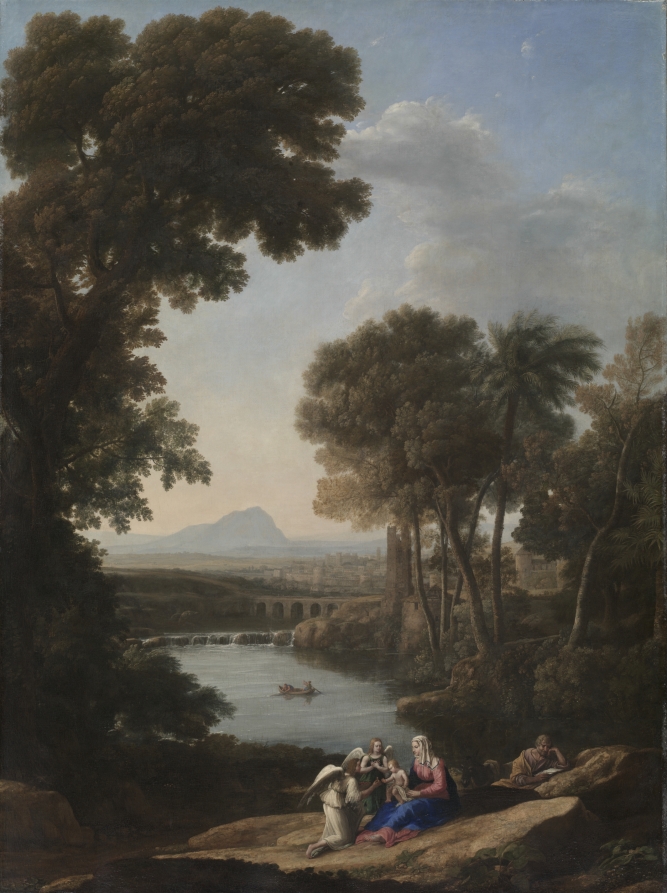
One of the most influential landscape painters of the early modern era, Lorrain was a master of the “ideal landscape,” which combined lush foliage and a tranquil atmosphere with allusions to an idyllic, imaginary past. The intention was to create views more beautiful and harmonious than nature itself. In the foreground of this soaring landscape, the Holy Family rests on a shady bank as kneeling angels offer fruit to the Christ child. Landscape paintings like this were much in demand among wealthy collectors throughout Europe, for whom these expansive idealized scenes represented a calm retreat from their hectic city lives.
Provenance
Count Francesco Crescenzi or Giovanni Battista Crescenzi (1577-1660?), Spanish Marquess de la Torre;; Sir William Lowther (1727-1753), third and last Baronet of Marske (Holker Hall, Lancashire);; by inheritance to Lord George Augustus Cavendish (died 1794), Holker Hall, Lancashire;; by inheritance to William Cavendish (1808-1891), seventh Duke of Devonshire and second Earl of Burlington;; Lord Richard Frederick Cavendish (1871-1946); sale, Christie's, London, December 12, 1930, no. 37, illus.;; Richard Edward Osborne Cavendish, Esq., Holker Hall, Lancashire;; sold, Christie's, London, April 1, 1960, no. 87, illus., to Rudolf Heinemann, New York;; sold the the Cleveland Museum of Art, 1962.
Accession Number
1962.151
Medium
oil on canvas
Dimensions
Framed: 239 x 185 x 12 cm (94 1/8 x 72 13/16 x 4 3/4 in.); Unframed: 208 x 152.5 cm (81 7/8 x 60 1/16 in.)
Classification
Painting
Credit Line
Leonard C. Hanna Jr. Fund