Description
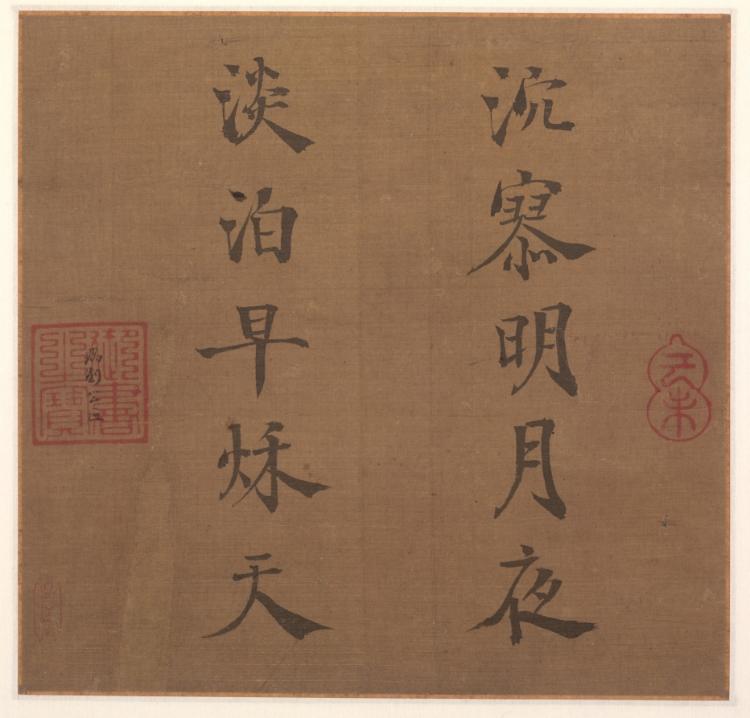
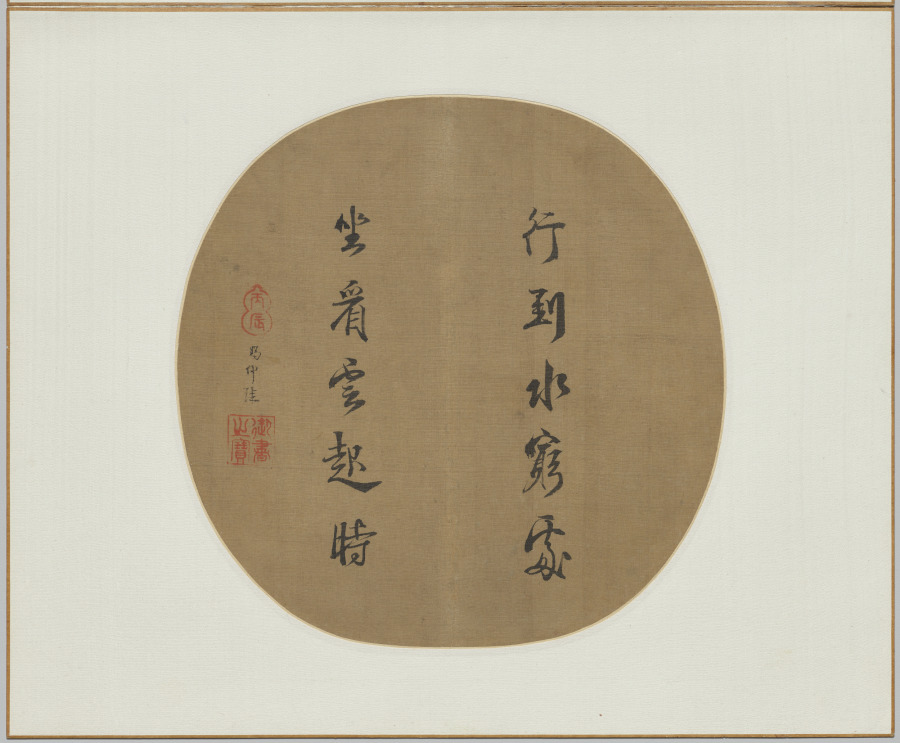
Poem and painting, once mounted together as one fan, exemplify the collaboration between imperial patron and court painter. Emperor Lizong’s calligraphy cites a verse from Wang Wei’s (701–761) poem, Walking to where the water ends, I sit and watch when clouds arise.
Ma Lin’s response is this painting. At the water’s edge, a scholar reclines by a large rock. The view leads across the empty middle ground to a distant mountain. With sparse ink and subtly graded washes, Ma Lin visualizes the poetic verse. The painting suggests the impact of Chan aesthetics through interaction between the palace, literati-officials, and monasteries around Hangzhou.
The leaf facing Emperor Lizong’s calligraphy has an inscription by Zhang Daqian (1899–1983).
Ma Lin’s response is this painting. At the water’s edge, a scholar reclines by a large rock. The view leads across the empty middle ground to a distant mountain. With sparse ink and subtly graded washes, Ma Lin visualizes the poetic verse. The painting suggests the impact of Chan aesthetics through interaction between the palace, literati-officials, and monasteries around Hangzhou.
The leaf facing Emperor Lizong’s calligraphy has an inscription by Zhang Daqian (1899–1983).
Provenance
(Nagatani, Inc., Chicago, IL, sold the Cleveland Museum of Art) (?–1961); The Cleveland Museum of Art, Cleveland, OH (1961–)
Accession Number
1961.421.2
Medium
Album leaf; ink on silk
Dimensions
Image: 25.1 x 25.3 cm (9 7/8 x 9 15/16 in.); with mat: 33.3 x 40.5 cm (13 1/8 x 15 15/16 in.)
Classification
Calligraphy
Credit Line
John L. Severance Fund