Description
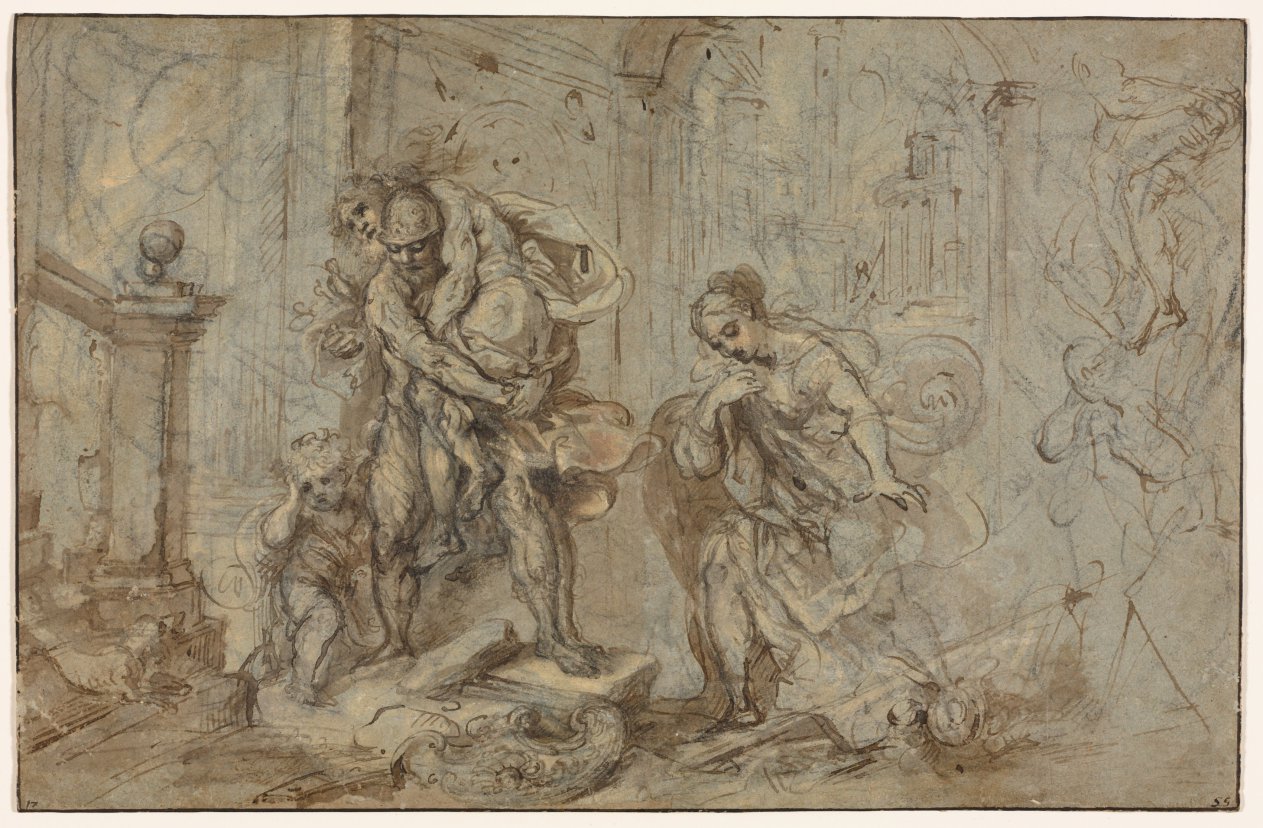
In book two of Virgil's epic poem The Aeneid (29-19 BC), the Trojan hero Aeneas escapes from the burning city of Troy and its Greek invaders with his family. Here the artist shows them making their way through a classical corridor. Aeneas carries his elderly father, Anchises, entrusted with holding their household gods. Aeneas holds the hand of his son, Ascanius, and his wife Creusa follows behind. Creusa's separation from the group alludes to her fate: she will fall behind and not survive their flight. Quick sketches on the right border of the sheet show Barocci practicing the balancing pose of Aeneas as he carries his father, and the stance of Creusa. The drawing relates to a now lost painting by Barocci and was also made into an engraving by Agostino Carracci (see CMA 1963.456). Details in the drawing such as the dog bounding down the stairs and Creusa's flowing hair and head scarf do not appear in the engraving.
Provenance
Possibly Peter Paul Rubens (1577-1640), Antwerp, (according to Jaffé 1963).; Pierre Crozat (1665-1740), Paris. (?-1740); his sale, 10 April-13 May 1741, lot 248. (1741); Jean Baptiste François Nourri (1697-1784), Paris (?-1784); his sale, 24 February-14 March 1785, lot 119. (1785); Charles Paul Jean Baptiste de Bourgevin Vialart de Moligny, comte de Saint-Morys (1743-1795), Paris; Guichardot, Paris (?-1875); his sale, Paris, 7-10 July 1875, no. 18 (1875); with Erardo Aeschlimann, Milan. (1960); The Cleveland Museum of Art, Cleveland, OH (1960-)
Accession Number
1960.26
Medium
Pen and brown ink, brush and brown wash and yellow gouache heightened with traces of white, over black chalk, with stylus (banister); framing lines in pen and brown ink
Dimensions
Sheet: 27.7 x 42.6 cm (10 7/8 x 16 3/4 in.)
Classification
Drawing
Credit Line
L. E. Holden Fund