Description
Monk Juran served the Southern Tang (937–75) imperial house in Nanjing, where he studied with Dong Yuan (active 930s–60s). Both founded the southern landscape tradition, or Jiangnan school, known for gentle misty riverscapes in wet ink.
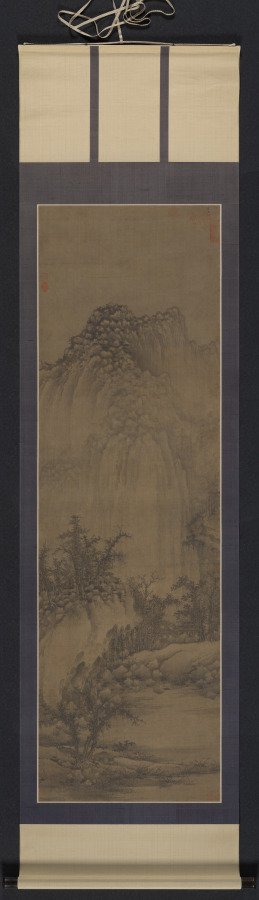
Juran moved north to Kaifeng when the Southern Tang surrendered to the Northern Song, the impact of which may be seen in this painting, presumably painted after 976. A towering mountain dominates the composition, typically representing the style of the Northern Song academy; while the use of long hemp fiber strokes to texture the mountains, wet dots, and round boulders on mountain tops are elements of the southern landscape tradition.
Juran moved north to Kaifeng when the Southern Tang surrendered to the Northern Song, the impact of which may be seen in this painting, presumably painted after 976. A towering mountain dominates the composition, typically representing the style of the Northern Song academy; while the use of long hemp fiber strokes to texture the mountains, wet dots, and round boulders on mountain tops are elements of the southern landscape tradition.
Provenance
Song government (Shang Shu Sheng yin 尚書省印), Beijing, China (960-1279); Ming government (half-seal Si yin 司印), Beijing, China (1368–98); Wu Ting 吳廷 (first half of 1600s) (first half of 1600s); Liang Qingbiao 梁清標 [1620–1691] (1620–1691); Geng Zhaozhong 耿昭忠 [1640–1686] (1640–86); An Qi 安岐 [c. 1683–c. 1744] (c. 1683–c. 1744); Qing imperial collection (seals of the Qianlong Emperor), Beijing. China (1736–95); Shao Fu-hsing, Beijing, China (early 1900s); Frank F. Cho, New York, NY (?–1959); Katharine Holden Thayer [1898–1985], Gates Mills, OH, given to the Cleveland Museum of Art (?–1959); The Cleveland Museum of Art, Cleveland, OH (1959–)
Accession Number
1959.348
Medium
Hanging scroll; ink on silk
Dimensions
Painting only: 184.5 x 56.1 cm (72 5/8 x 22 1/16 in.); Overall with knobs: 260.5 x 77.4 cm (102 9/16 x 30 1/2 in.)
Classification
Painting
Credit Line
Gift of Katharine Holden Thayer