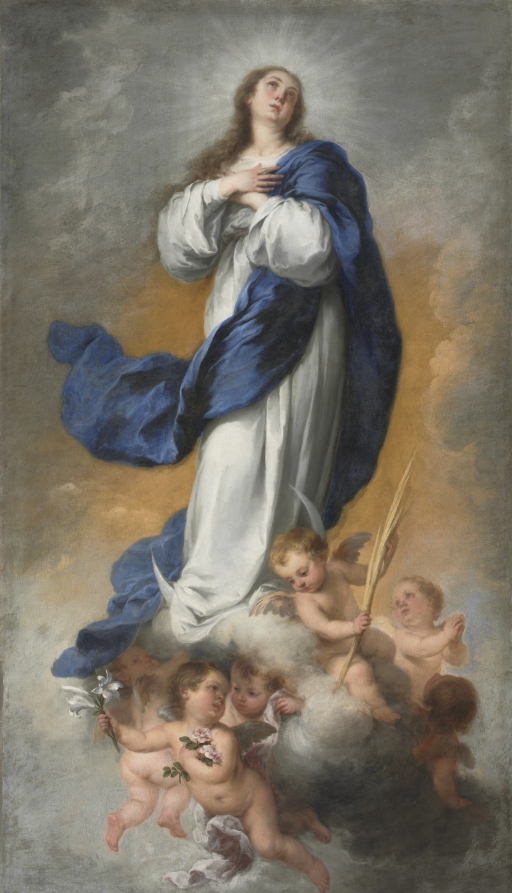
Description
The doctrine of the Immaculate Conception maintains that the Virgin Mary was conceived free from sin, therefore ready to be the pure vessel for Christ’s birth. The Immaculate Conception enjoyed intense devotion in Spain during the 1600s, although it was only accepted as official doctrine in 1854. The abstract subject required artists to develop appropriate imagery. The crescent moon, for example, comes from the New Testament vision of Saint John the Evangelist (Revelation 12:1) of “a woman clothed with the sun, with the moon under her feet.”
Provenance
Sir Thomas Sebright, Beechwood near Boxmoor, Hertfordshire; [F. Kleinberger &: Co., New York]. Purchase, Leonard C. Hanna Jr. Bequest, 1959.
Accession Number
1959.189
Medium
oil on canvas
Dimensions
Framed: 246.3 x 152.7 x 8 cm (96 15/16 x 60 1/8 x 3 1/8 in.); Unframed: 220.5 x 127.5 cm (86 13/16 x 50 3/16 in.)
Classification
Painting
Credit Line
Leonard C. Hanna Jr. Fund