Description
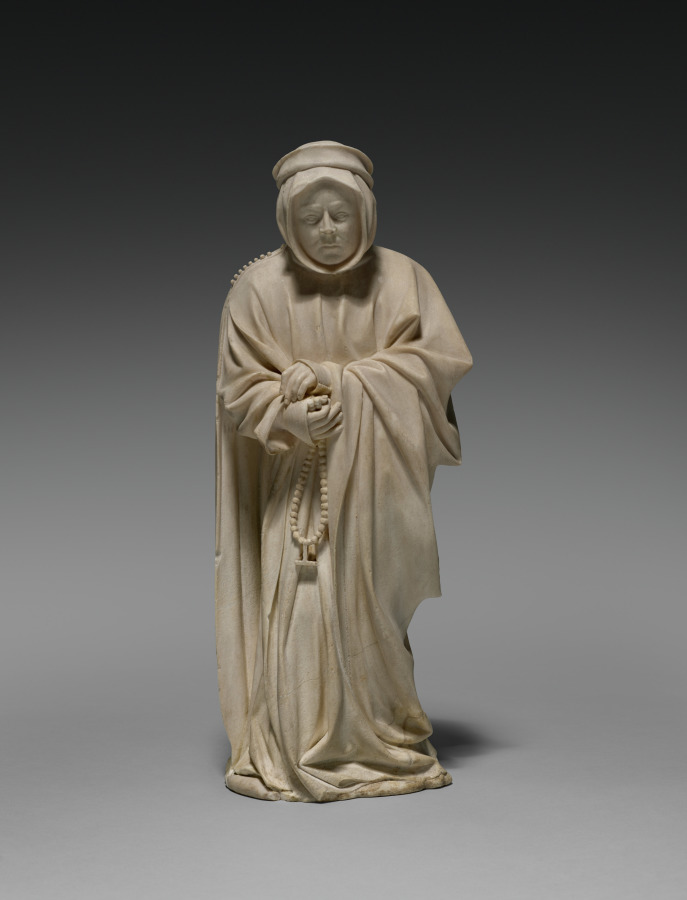
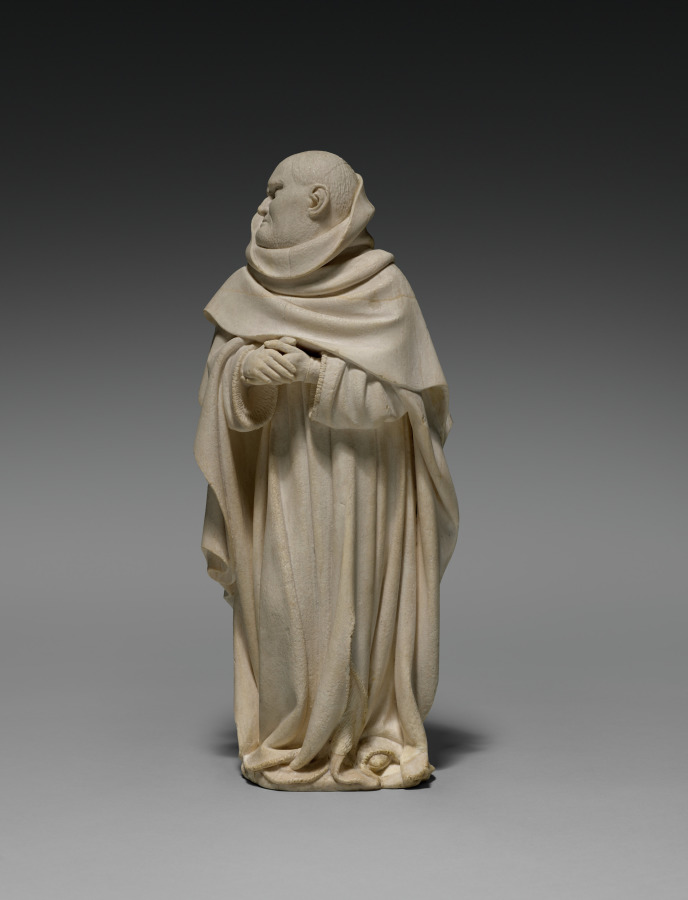
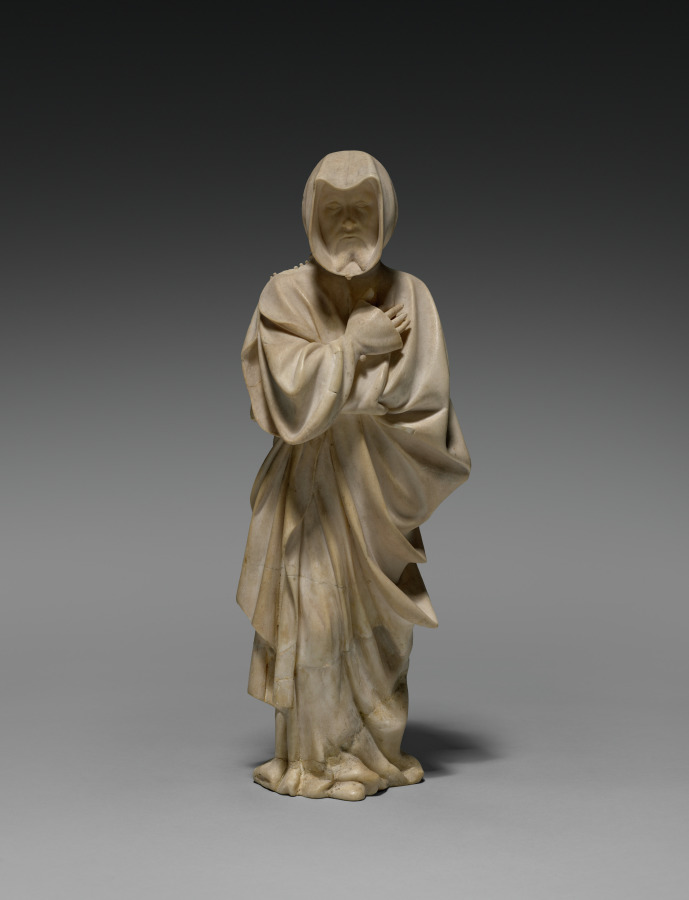
This figure comes from the tomb of Duke Philip the Bold from the church of Champmol near Dijon (Burgundy, France). Philip, who founded the monastery and designated it as his burial place, hired the best artists, many of whom came from the Netherlands. While the commission was given in 1381, the work was not completed until 1410, six years after the duke’s death.
This mourner is unusual for the time because it is not carved as a static low relief on the pedestal of the tomb but interacts with the viewers and their fellow procession members. The lifelike quality of the figure is due in large part to the alabaster. Its softness allowed artists to carve details into the material, and the transparent, milky white stone could also be polished to a high gloss.
This mourner is unusual for the time because it is not carved as a static low relief on the pedestal of the tomb but interacts with the viewers and their fellow procession members. The lifelike quality of the figure is due in large part to the alabaster. Its softness allowed artists to carve details into the material, and the transparent, milky white stone could also be polished to a high gloss.
Provenance
M. M. Hocquart, Dijon, France; Vicomte Edouard de Broissia & son, Georges, (d. 1875) Dijon, France (-1875); (M. Legley, Nancy, sold to Charles Stein) (1875-?); (Charles Stein, Paris, France); Baron Arthur de Schickler, Paris, France; Count de Pourtales, Paris, France; (Duveen Bros., Paris, France) (1919-?); Clarence Mackay (d. 1939), New York, NY (by 1922-1939); (Jacques Seligmann, New York, sold to Leonard C. Hanna) (1939-1940); Leonard C. Hanna, Cleveland, OH, bequest to the Cleveland Museum of Art (1940-1958); The Cleveland Museum of Art, Cleveland, OH (1958-)
Accession Number
1958.66
Medium
vizille alabaster
Dimensions
Overall: 41 x 12.7 x 15 cm (16 1/8 x 5 x 5 7/8 in.)
Classification
Sculpture
Credit Line
Bequest of Leonard C. Hanna Jr.