Description
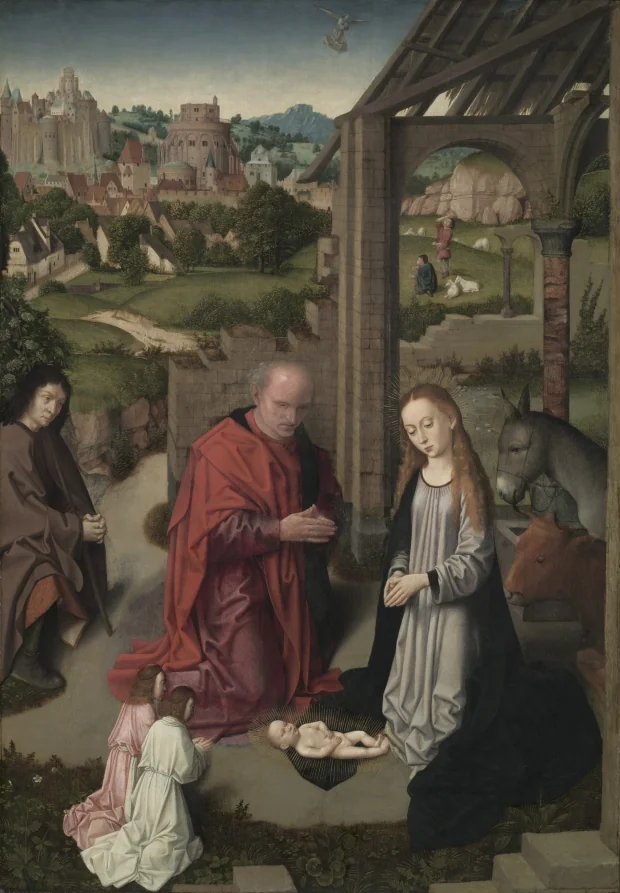
The nativity was one of the most frequently depicted subjects in western art. The event marks the entrance of Christ into the world and the fulfillment of Old Testament prophecy. In the distance an angel announces the birth of Christ to the shepherds tending their flocks. One shepherd is already at the stable adoring the Christ child. In the background, the cityscape represents Jerusalem, where Christ would be crucified, represented here as a northern medieval city. Only Matthew and Luke describe Christ’s nativity in the Gospels, which led medieval writers and artists to amplify the event. Some scholars have suggested that the head of Joseph is a donor portrait. Gerard David was born in Oudewater, now located in Utrecht. He spent his mature career in Bruges, where he was a member of the painters’ guild. Upon the death of Hans Memling in 1494, David became Bruges’s leading painter of devotional panels. He was also a manuscript illuminator.
Provenance
Possibly from a Russian coll.; Richard von Kaufmann, Berlin, 1898; (Cassirer and Helbing, Berlin sale, December 4, 1917, no. 78); Walter von Pannwitz, Berlin; Frau C. von Pannwitz, Hartekamp near Haarlem (1917); (Rosenberg & Stiebel, NY)
Accession Number
1958.320
Medium
oil on wood panel
Dimensions
Framed: 102.5 x 76 x 7.5 cm (40 3/8 x 29 15/16 x 2 15/16 in.); Unframed: 85.2 x 59.7 cm (33 9/16 x 23 1/2 in.)
Classification
Painting
Credit Line
Leonard C. Hanna Jr. Fund
Tags
Painting Renaissance (1400–1599) Oil Painting Panel Painting Netherlandish
Background & Context
Background Story
Gerard David (c. 1460-1523) was a Netherlandish painter known for the serene, detailed manner that makes him one of the most accomplished painters of the Early Netherlandish tradition. The Nativity from c. 1485-90 depicts the birth of Christ in the serene, detailed manner that distinguishes David's best religious paintings from the more emotional work of his contemporaries. The c. 1485-90 date places this in David's early period, when he was producing the serene, detailed religious paintings that would establish his reputation as one of the most accomplished painters of the Netherlandish tradition.
Cultural Impact
The Nativity is important in the history of Netherlandish painting because it demonstrates the serene, detailed manner that David brought to religious subjects as one of the last great masters of the Early Netherlandish tradition. David's combination of serene composition with detailed observation represents the Early Netherlandish tradition at its most accomplished, and The Nativity shows this tradition in one of its most important subjects.
Why It Matters
The Nativity is Gerard David's serene Netherlandish manner: the birth of Christ rendered in the detailed, peaceful composition that distinguishes one of the last great masters of the Early Netherlandish tradition. The c. 1485-90 painting shows the Netherlandish tradition at its most serene and accomplished.
![Saint Bernard and Saint Catherine of Alexandria with the Virgin of the Annunciation [right panel]](https://api.nga.gov/iiif/e6890364-4d99-4684-a62b-5060ee3c3446/full/400,/0/default.jpg)