Description
Similar to some calligraphers of his time, Zhu Da rejected conventions in favor of an individual, personal expression. He is known for ambiguous compositions of fish, flowers, birds, and rocks in contrasting ink tonality. As a member of the Ming imperial family, Zhu lost his princely status and hid in a monastery when the Manchus, foreigners from the north, established the Qing dynasty in 1644.
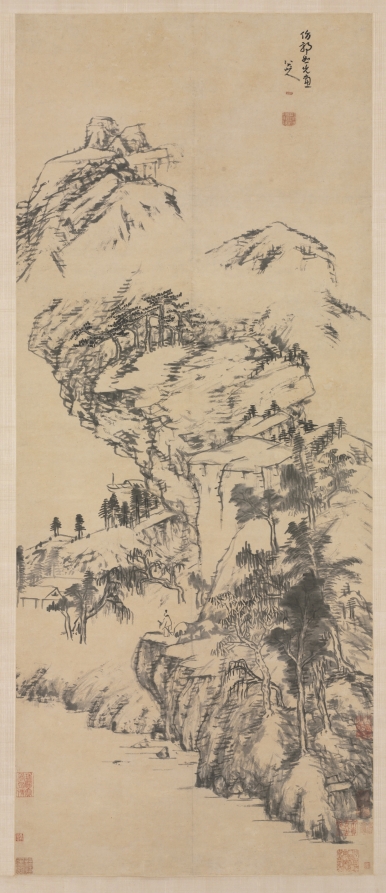
In this late work, mountain ranges are rendered in diverse and dense strokes rising toward the top of the scroll. It references the artist Dong Qichang (1555–1636) in concept. Yet the cursory brushwork and composition present Zhu’s personal style.
In this late work, mountain ranges are rendered in diverse and dense strokes rising toward the top of the scroll. It references the artist Dong Qichang (1555–1636) in concept. Yet the cursory brushwork and composition present Zhu’s personal style.
Provenance
Chang Dai-chien [Zhang Daqian 張大千] [1899–1983]; (Walter Hochstadter [1914–2007], New York, NY, sold to the Cleveland Museum of Art) (?–1955); The Cleveland Museum of Art, Cleveland, OH (1955–)
Accession Number
1955.36
Medium
Hanging scroll; ink on paper
Dimensions
Painting: 109.9 x 56.4 cm (43 1/4 x 22 3/16 in.); Overall with knobs: 247.7 x 84.5 cm (97 1/2 x 33 1/4 in.)
Classification
Painting
Credit Line
John L. Severance Fund