Provenance
Lord Thomas Philip Lucas, Wrest Park, Bedfordshire (according to departmental card; Lugt 1696, not stamped). Lady Lucas, Wrest Park, Bedfordshire (according to departmental card; Lugt 1696, not stamped). P.M. Turner (according to departmental card). [Colnaghi, London] (according to departmental card). [H. M. Calmann, London] (according to departmental card)
Accession Number
1955.159.b
Medium
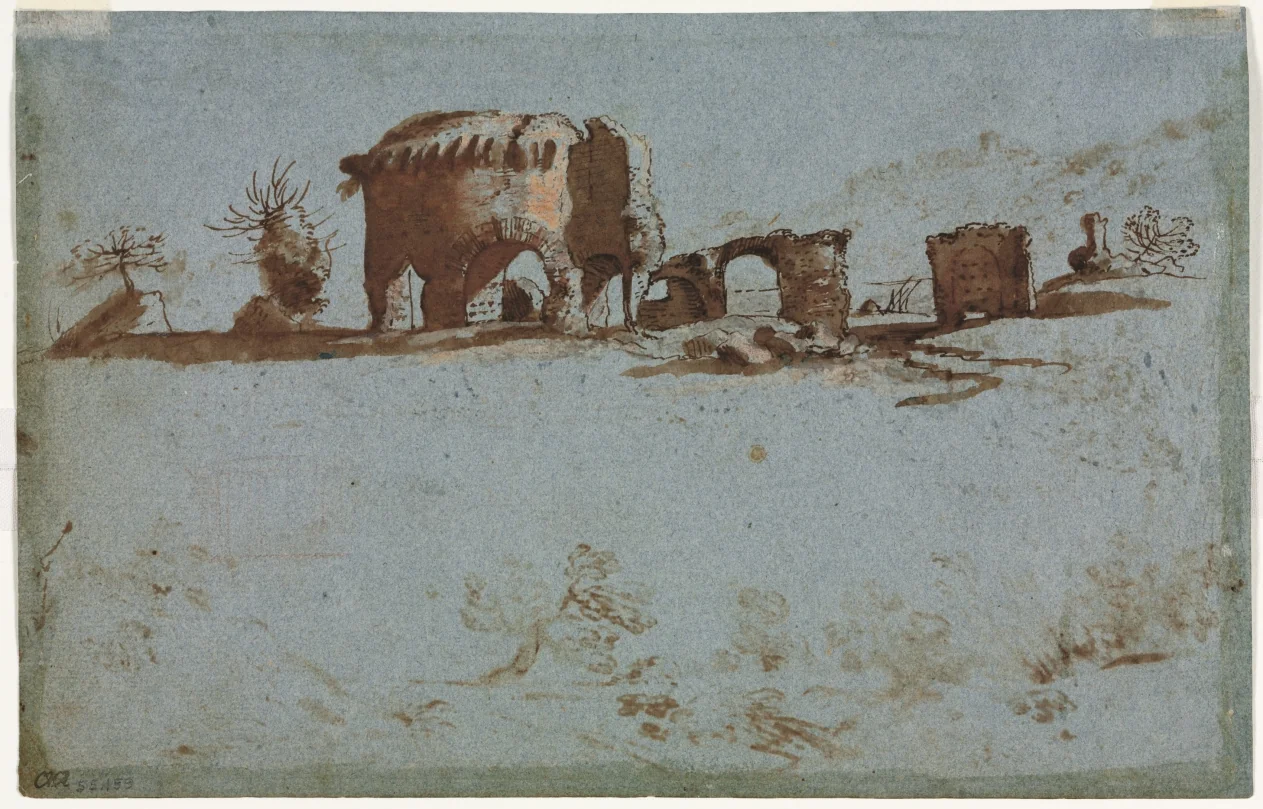
pen and brown ink and brush and brown wash with red chalk, heightened with white and orange gouache
Dimensions
Sheet: 16.7 x 26 cm (6 9/16 x 10 1/4 in.)
Classification
Drawing
Credit Line
John L. Severance Fund
Tags
Drawing Baroque (1600–1750) Ink Gouache
Background & Context
Background Story
Small Group of Roman Ruins (verso), dating from around 1650 and attributed to an unknown artist, depicts the remnants of ancient Rome that had been a subject of artistic fascination since the Renaissance. By 1650, Roman ruins were not merely archaeological subjects but had become integral to the visual vocabulary of European art, serving as symbols of transience, historical continuity, and the enduring legacy of classical civilization. The term verso indicates this image is on the reverse side of another work, a practice common in the seventeenth century when artists and students used both sides of paper or panel for studies, sketches, and compositional experiments. Small groups of Roman ruins were popular subjects for several reasons: they allowed artists to demonstrate their knowledge of classical architecture, they provided opportunities for atmospheric effects of light and shadow on weathered stone, and they satisfied the growing market for Roman views among Grand Tour travelers and collectors. The ruins of Rome—whether the Colosseum, the Forum, or scattered temples and arches—carried layers of meaning that extended far beyond their architectural interest. They represented the fall of great civilizations (the memento mori of empires), the preservation of cultural memory, and the Renaissance project of recovering classical knowledge. Painted around 1650, during the Baroque period, this work emerged in an era when the Catholic Church was actively commissioning art that emphasized both Rome's imperial past and its continuing spiritual authority.
Cultural Impact
Seventeenth-century paintings of Roman ruins shaped the European understanding of classical heritage, simultaneously preserving archaeological knowledge and creating a visual language around transience and the persistence of cultural memory.
Why It Matters
This verso study reveals both the practical economy of seventeenth-century artistic practice and the enduring symbolic power of Roman ruins as subjects that connected Baroque viewers to their classical heritage.