Description
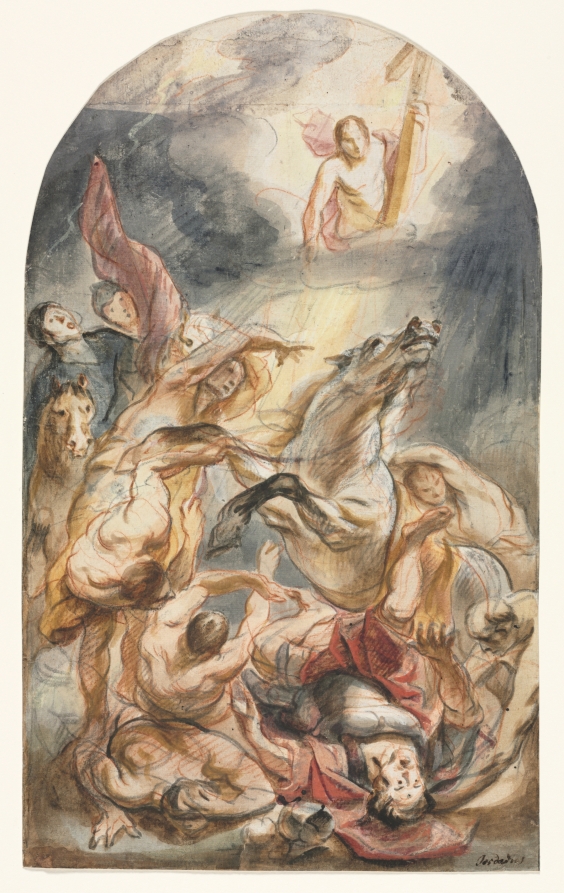
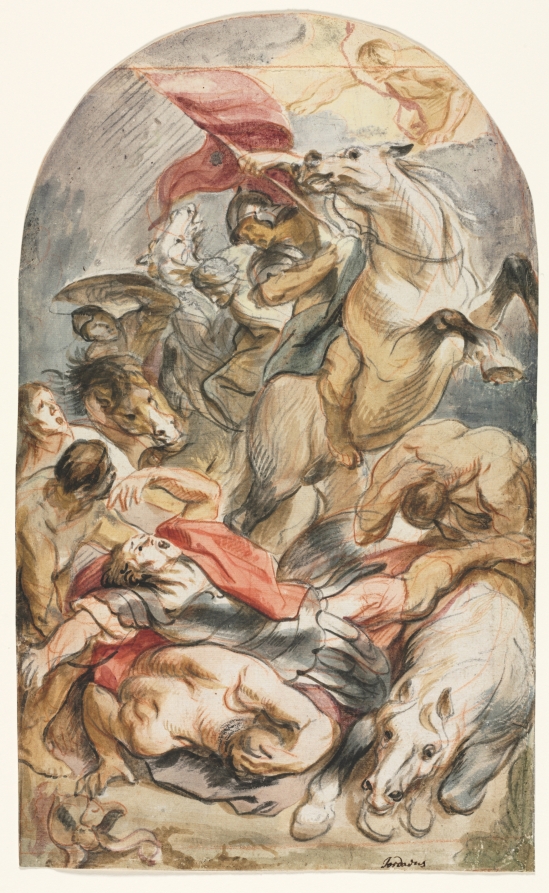
Jacob Jordaens was a prominent artist working in Antwerp in the 17th century. Though influenced in his use of powerful forms and vibrant color by his contemporary, Peter Paul Rubens, Jordaens was notably more realist in his tendencies. This drawing and its companion drawing in the Cleveland Museum of Art's collection (1954.367) are studies for a painting depicting the Conversion of St. Paul that Jordaens made for the the abbey church at Tongerlo, near Antwerp, in around 1647 (now lost). According to the Bible, in the year following the death of Jesus Christ, Saul of Tarsus (who became Saint Paul) was on the road to Damascus. He was suddenly surrounded by a brilliant light from above, heard the voice of Christ, and became a believer. In this work, Jordaens illustrated the climactic moment when Saul is thrown to the ground by the force of Christ's voice and blinding light. Jordaens used a combination of chalks and wet media such as ink and watercolor to create a swirling mass of bodies bathed in light.
Provenance
Duke Albert of Sachsen-Teschen (according to cma files). Graphische Sammlung Albertina, Vienna (Lugt 1259-60, not stamped, according to cma files). Otto Burchard (according to cma files). [Heinrich Eisemann, London].
Accession Number
1954.366
Medium
Black and red chalk, pen and black and gray ink, brush and brown wash, watercolor, and gouache, heightened with white gouache; framing lines in red chalk and graphite (right edge)
Dimensions
Sheet: 32.9 x 19.9 cm (12 15/16 x 7 13/16 in.)
Classification
Drawing
Credit Line
Delia E. Holden and L. E. Holden Funds