Description
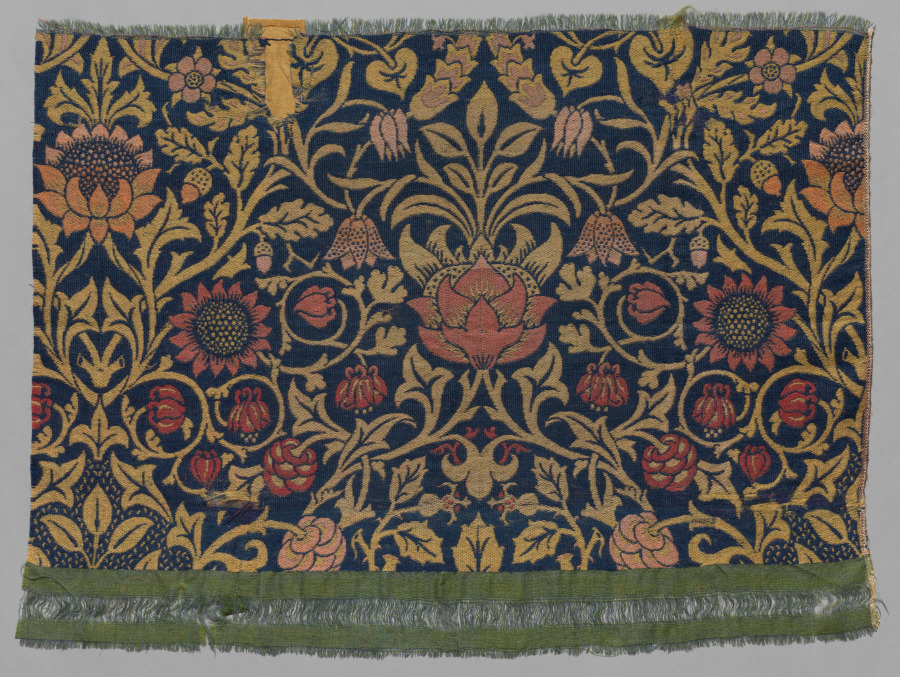
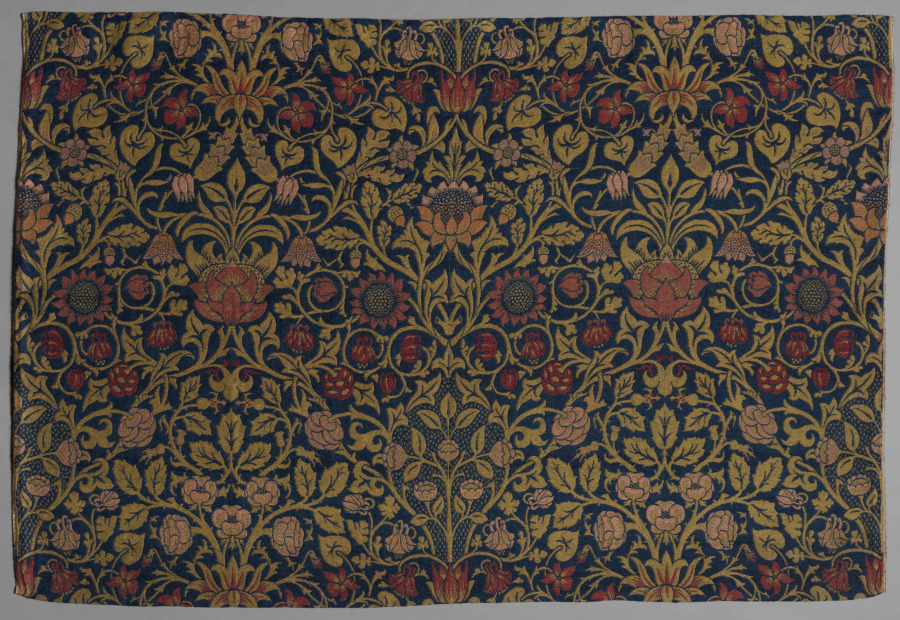
Morris envisioned textiles such as Violet and Columbine hanging in heavy folds, the rich colors and flowing pattern suggesting a garden wall. He strongly preferred experimenting with natural dyes instead of using the garish chemical ones that had become standard in industrialized England. Even though organic dyes were expensive and scarce, and required dyers to revive old methods, they were less likely to fade in the light or during washing, and they were capable of producing more subtle tonal effects. A sense of the process of hand-weaving can be understood by looking at the back of this textile. The warp (up and down) threads are light blue and green—visible at the bottom. The textile was woven in long lengths that could be cut at these passages of loose thread. The weft (side to side) threads in several colors, including red, pink, yellow, and blue, are more visible from the back than the front, where they disappear into the pattern.
Provenance
the textile was purchased by George Willis Pack, grandfather of Mrs. White, between 1883-1886 for his home at 695 Euclid Avenue, Cleveland.
Accession Number
1953.329
Medium
jacquard loom woven weft-faced twill, double cloth; wool and mohair
Dimensions
Overall: 122.6 x 180.7 cm (48 1/4 x 71 1/8 in.)
Classification
Textile
Credit Line
Gift of Mrs. Philip White