Description
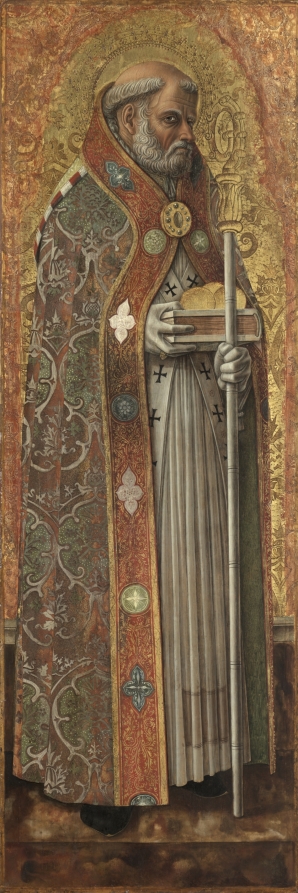
Saint Nicolas of Bari, patron saint of children, sailors, and travelers, and the prototype of Father Christmas, was bishop of Myra (Lycia) in Asia Minor during the AD 300s. His remains were said to have been taken to Bari in Italy during the 11th century. The saint is shown vested as bishop in an elaborately embroidered cope, fastened with a morse, and holding a crosier.
By the mid-1400s, most Florentine artists had stopped using gold backgrounds in their pictures, preferring instead naturalistic backgrounds of landscapes and blue skies. However, elsewhere in Italy gold-ground painting remained popular, as in this painting by Crivelli, a a painter of conservative Late Gothic decorative sensibility, who spent his early years in the Veneto where he absorbed influences from the Vivarini, Squarcione, and Mantegna. By 1458 he left the Veneto and was never to return; he spent most of the remainder of his career in the March of Ancona, where he developed a distinctive personal style that makes a contrast to his Venetian contemporary Giovanni Bellini.
By the mid-1400s, most Florentine artists had stopped using gold backgrounds in their pictures, preferring instead naturalistic backgrounds of landscapes and blue skies. However, elsewhere in Italy gold-ground painting remained popular, as in this painting by Crivelli, a a painter of conservative Late Gothic decorative sensibility, who spent his early years in the Veneto where he absorbed influences from the Vivarini, Squarcione, and Mantegna. By 1458 he left the Veneto and was never to return; he spent most of the remainder of his career in the March of Ancona, where he developed a distinctive personal style that makes a contrast to his Venetian contemporary Giovanni Bellini.
Provenance
Cardinal Fesch (Rome sale 1845); W. Davenport-Bromley, Wooton Hall (London sale 1863); Baroness Kerbeck, Paris; (Knoedler)
Accession Number
1952.111
Medium
Tempera and gold leaf on wood panel
Dimensions
Framed: 109 x 41 x 6 cm (42 15/16 x 16 1/8 x 2 3/8 in.); Unframed: 96.2 x 32 cm (37 7/8 x 12 5/8 in.)
Classification
Painting
Credit Line
Gift of the Hanna Fund