Description
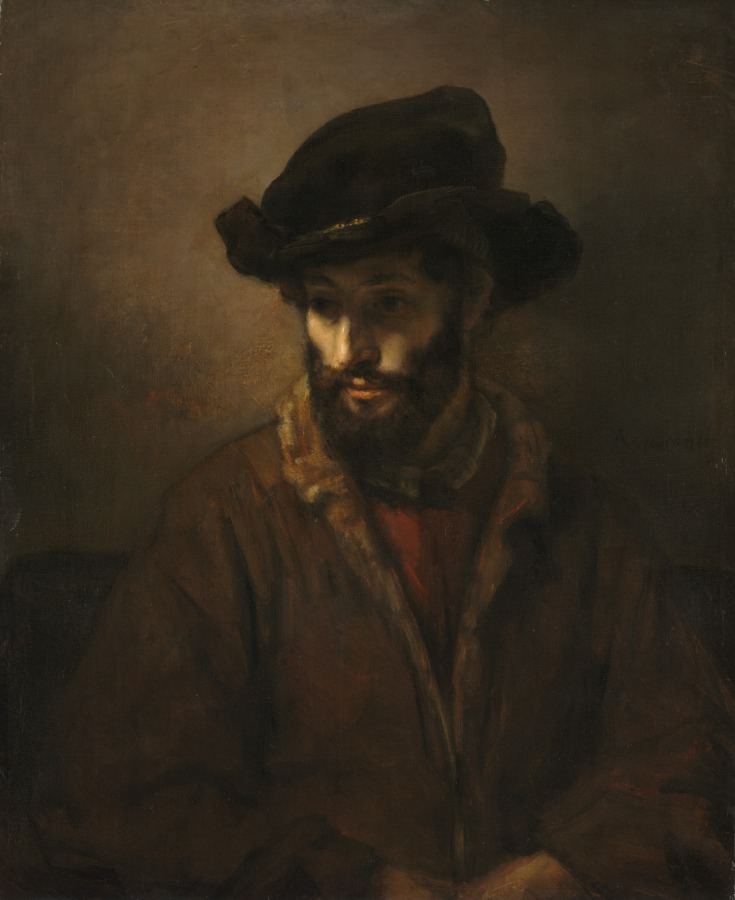
Amsterdam of the early 1600s was a religiously tolerant city, attracting many Jewish settlers of both Sephardic (Spanish and Portuguese) origin and Ashkenazic (Eastern European) descent. Rembrandt lived among both denominations and found inspiration in the manner and dress of the Ashkenazim, who maintained traditional comportment and attire and were less affluent than their Sephardim counterparts. As a result, many of the unidentified portraits from Rembrandt's late period once carried Jewish associations, but because of a lack of sufficient evidence, those assignations have since been reconsidered. Such is the case with Portrait of a Man, which was once considered a portrait of the Dutch Jewish philosopher Baruch Spinoza (1632–1677) as well as a representation of a Jewish student. Rembrandt's authorship of the painting has also undergone reassessment. The broad and thinly painted cloak and hat suggests the painting is likely a workshop product and while it does display Rembrandt's characteristic interest in a sitter's introspection, the figure's thoughtfulness remains comparatively superficial.
Provenance
Paul Delaroff (St. Petersburg, Russia), 1906; Thomas Agnew & Sons (London, England); Scott & Fowles (New York, New York); Otto H. Kahn (New York, New York), 1910, presented by his children to the Metropolitan Opera Association, New York, 1950;; Metropolitan Opera Association, sold through M. Knoedler & Co., (New York, New York), to the Cleveland Museum of Art, 1950.; The Cleveland Museum of Art, Cleveland, OH (1950-)
Accession Number
1950.252
Medium
oil on canvas
Dimensions
Framed: 119.4 x 104.1 x 14.6 cm (47 x 41 x 5 3/4 in.); Unframed: 84.5 x 69.2 cm (33 1/4 x 27 1/4 in.)
Classification
Painting
Credit Line
Gift of the Hanna Fund
Tags
Painting Baroque (1600–1750) Oil Painting Canvas Dutch
Background & Context
Background Story
A Bearded Man Wearing a Hat (c. 1650-1660) is one of Rembrandt's characteristic studies of anonymous figures—.tronies that used real models to depict character types rather than specific individuals. The tronie, a distinct category in Dutch Golden Age painting, depicted figures in exotic or historical costume whose identity was less important than the character they represented. Rembrandt's bearded man, with his weathered face and his hat's characterful shadow, embodies the wisdom, experience, and weathered humanity that the artist consistently found in ordinary faces. The 1650-60 date places this during Rembrandt's mature period, when his handling had reached the expressive freedom that distinguishes his late work. His treatment of the bearded man demonstrates the method that made his late portraits among the most psychologically penetrating in Western art: the face emerges from shadow through a series of tonal gradations that model the features with a subtlety that no other painter of the period could match. The hat, casting its shadow across the face, creates the dramatic chiaroscuro that Rembrandt had made his signature—the interplay of light and shadow that revealed character by selectively illuminating the features that expressed inner life while concealing those that did not.
Cultural Impact
Rembrandt's tronies influenced how character types were represented in Dutch Golden Age painting, establishing the anonymous figure study as a significant artistic subject. The paintings influenced later artists who similarly found psychological depth in ordinary faces, from the Dutch genre painters to the portraitists of every subsequent century. The bearded man wearing a hat influenced how masculinity and wisdom were visually represented, connecting physical weathering to inner experience.
Why It Matters
This painting matters because it demonstrates Rembrandt's ability to find psychological depth in an anonymous face—the character that emerges through the chiaroscuro modeling argues that inner life is visible in physical appearance, and that the painter's task is not to record but to reveal the human significance that ordinary features carry.