Description
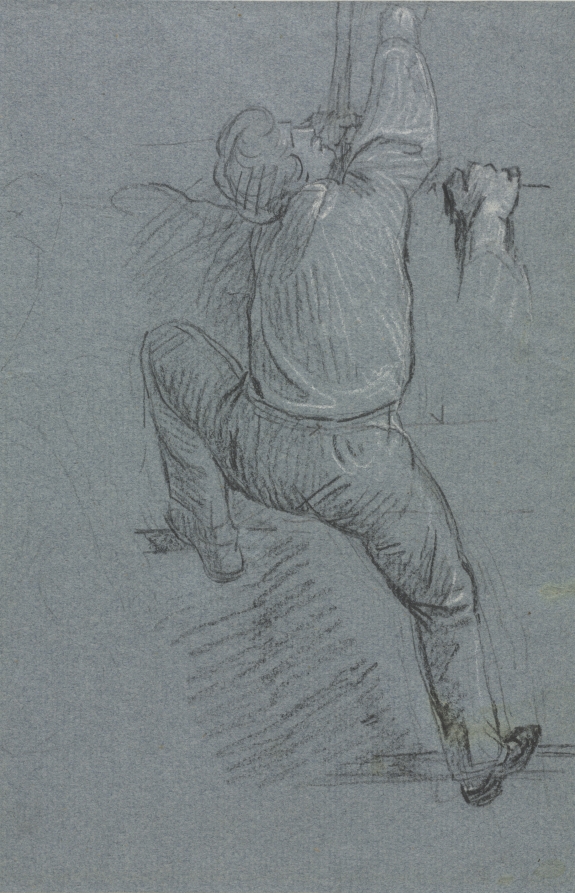
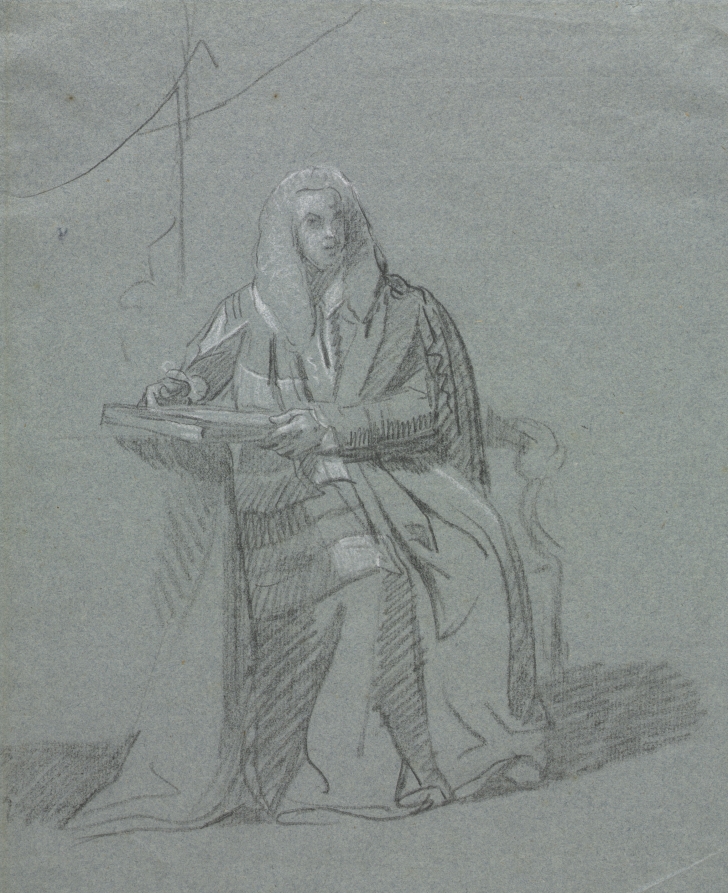
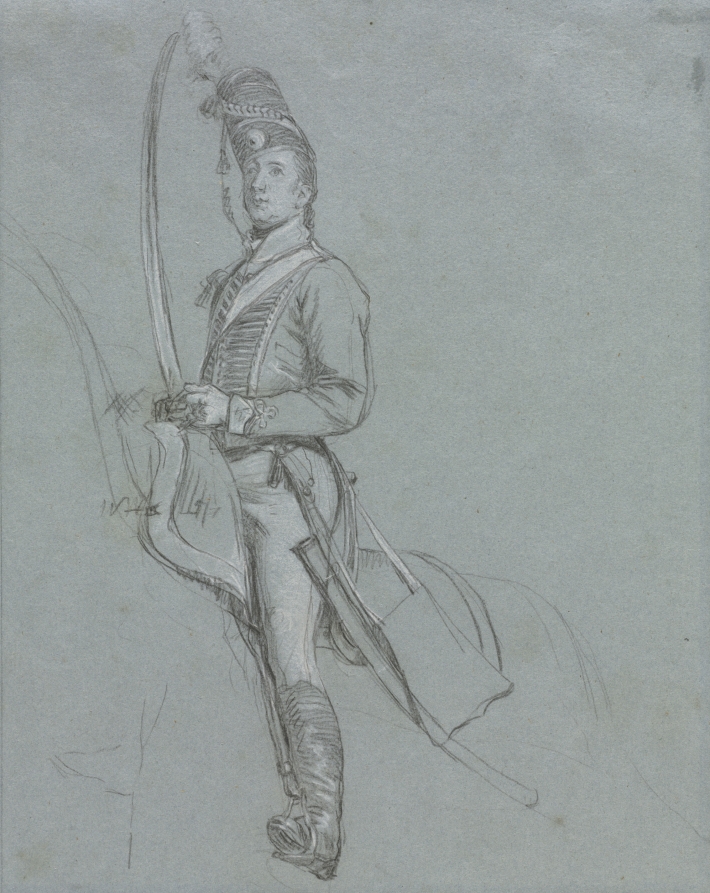
John Singleton Copley left Boston at the start of the American Revolution in 1775 to pursue his career in England, where he achieved distinction both as a portraitist and a history painter. Following a method often employed in France, Copley generally drew on blue paper to serve as a middle tone, working up the image using black chalk to indicate outlines and shadows, and white chalk for highlights. He made this drawing as an early study for the figure of the prince of Orange in his last major history painting, Battle of the Pyrenees (Museum of Fine Arts, Boston), in 1812–15. The figure is garbed in the uniform of a “hussar,” a light cavalry officer equipped with a saber, regiments of which played an important role in the Napoleonic Wars (1803–15). In the final composition, Copley used the pose not for Orange, but for the Duke of Wellington, changing the facial features and adjusting the position of the figure’s arms.
Provenance
The artist [1738-1815], London, England. (1812-?); John Singleton Copley, Jr., 1st Baron Lyndhurst (the artist’s son) [1772-1863], London, England. (?-1863); (The Lyndhurst Library Sale, Christie’s, London, 2/26/1864-2/27/1864, lot 670, likely sold to Edward Basil Jupp.) (1864); Edward Basil Jupp [1812-1877], London. (1864-?); Passed down through the Amory family: Martha Babcock Amory (granddaughter of the artist) [1812-1880], Boston, MA; Edward Linzee Amory (great-grandson of the artist) [1844-1911], Boston, MA; Mr. Wallace (valet to Edward Linzee Amory), Foxborough, MA. Sold to Charles D. Childs Gallery. (?-probably 1950); (Charles D. Childs Gallery, Boston, MA, sold to The Cleveland Museum of Art.) (1950); The Cleveland Museum of Art, Cleveland, OH. (1950-)
Accession Number
1950.216
Medium
black and white chalk
Dimensions
Sheet: 27.6 x 22.1 cm (10 7/8 x 8 11/16 in.)
Classification
Drawing
Credit Line
Norman O. Stone and Ella A. Stone Memorial Fund