Description
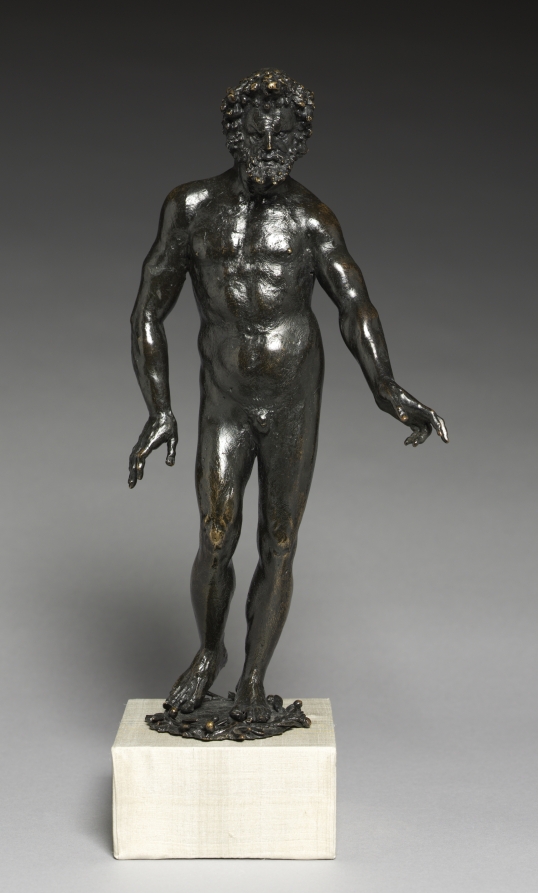
Derived from classical antiquity, this nude male stands in the contrapposto pose, bearing his weight on his left leg, with his right leg bent, as if in motion. He steps lightly, so that only the toes of his right leg touch the ground. He stands on a laurel wreath, a plant which in antiquity would be waved as a symbol of joy after a military victory. During the Renaissance, small bronzes were kept in cabinets, bringing the gods and goddesses of ancient times into the home. Flaws in the bronze casting suggest that this piece is from the early Renaissance. In 1971, Ulrich Middeldorf rejected Olga Raggio's original attribution to an anonymous Florentine, attributing it instead to the sixteenth-century Sienese artist Francesco di Giorgio Martini (1439-1501), based partly on its resemblance to Francesco's bronze angels in Siena's Duomo. However, such details as the awkward posture and frozen motion of the body relate this work more closely to Francesco's pupil Giacomo Cozzarelli (1453-1515). Standing Figure of a Man is attributed to the circle of Francesco di Giorgio Martini, as uncertainties remain regarding its exact author.
Provenance
Richard von Kaufmann, died 1908 (Berlin, Germany), upon his death, held in trust by the estate.; Estate of Richard von Kaufmann, sold, Cassirer and Helbing, Berlin, December 4, 1917, lot 254;; Dr. Ernö Wittmann (Budapest, Hungary), died 1963, sold through Raphael Stora (New York, New York), to the Cleveland Museum of Art, 1947.
Accession Number
1947.509
Medium
bronze
Dimensions
Overall: 31 x 16.5 x 8 cm (12 3/16 x 6 1/2 x 3 1/8 in.)
Classification
Sculpture
Credit Line
John L. Severance Fund