Description
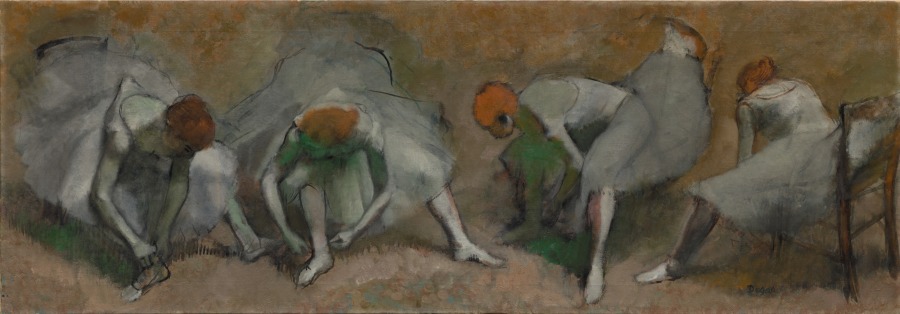
This painting may depict a single dancer seen from four different viewpoints. The young woman is placed in an undefined setting, surrounded by mere wisps of color, applied so spontaneously that the paint ran and dripped. Degas even added the circles in the foreground with his thumb. Such audacity, while acceptable in a small sketch, must have shocked the artist's contemporaries when presented on a six-foot canvas. Equally radical is the idea of combining multiple views of a single figure. Degas's unusual presentation may have been inspired by the photographs of Eadweard Muybridge (1830-1904)
Provenance
(Durand-Ruel, Paris, France, acquired from the artist and sold to Paul Cassier the same day) (September 19,1904); (Paul Cassirer, Berlin Germany, sold to Max Liebermann) (November 21, 1904); Max Liebermann [1847-1935], Berlin, Germany, deposited to the Kunsthaus Zürich (1904-May 9, 1933); Kunsthaus Zürich, Switzerland (1933-1935); Kathe Riezler, Max Leibermann's daughter, [1885-1952] Berlin, Germany and New York, NY, by inheritance (on loan to the Art Institute of Chicago, October 1941-October 1942). (1935-1946); (Paul Rosenberg & Co., New York, NY, sold to the Cleveland Museum of Art) (-1946); The Cleveland Museum of Art, Cleveland, OH (1946-)
Accession Number
1946.83
Medium
oil on fabric
Dimensions
Framed: 103 x 233.5 x 7 cm (40 9/16 x 91 15/16 x 2 3/4 in.); Unframed: 70 x 200.5 cm (27 9/16 x 78 15/16 in.)
Classification
Painting
Credit Line
Gift of the Hanna Fund