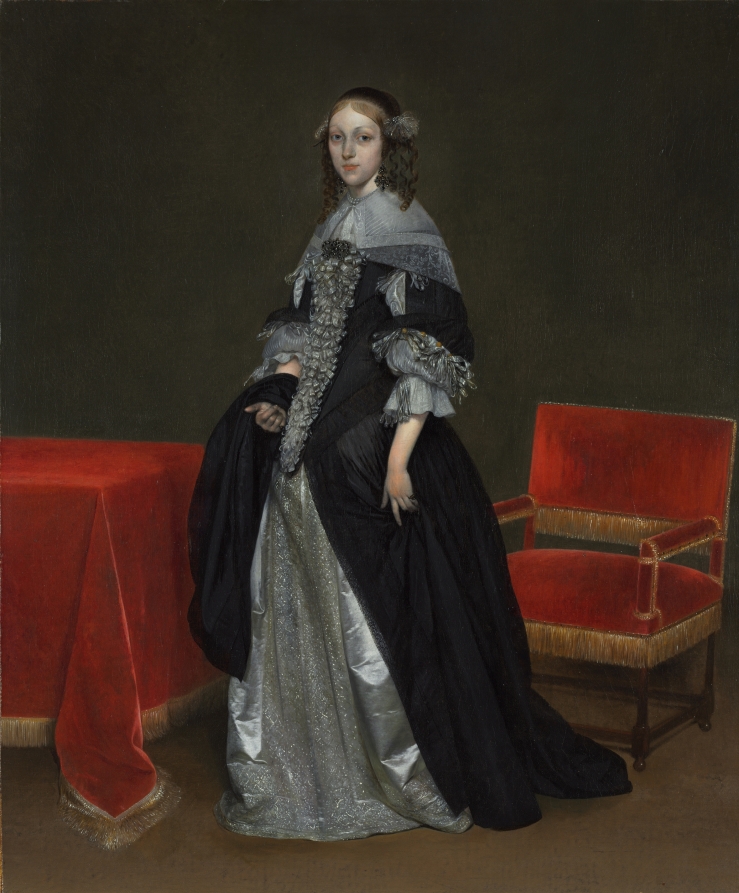
Description
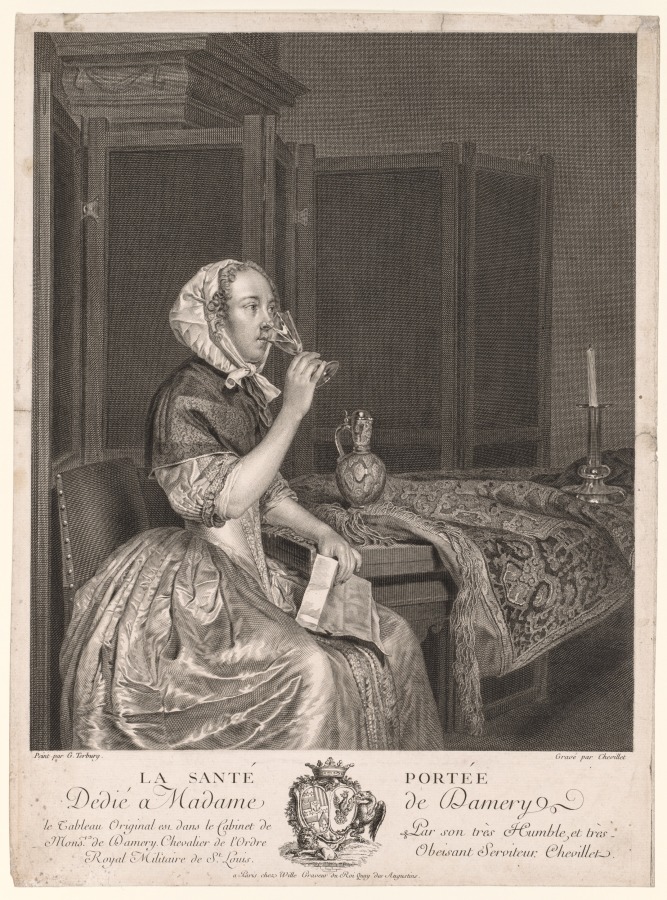
Every detail of his subject’s elaborate costume is skillfully recorded: glittering jewels, filmy lace, knots of ribbons, heavy black silk, and shimmering white satin. The ability to recreate satin’s luster was Gerard ter Borch’s particular trademark: he used fine flicks and sweeps of the brush, occasionally adding and wiping away tiny bits of paint to make the white fabric appear to shine. Ter Borch offset the profusion of costume detail by deliberately isolating the figure within a spare setting, allowing us to appreciate the woman’s cool composure. Although her identity is not known, she was undoubtedly a member of the wealthy Dutch elite.
Provenance
(presumably) Jan Jacob [Jean-Jacques de] Faesch [1755-1831], Amsterdam); (de Vries … Roos, Amsterdam, sale Jean-Jacques de Jean-Jacques de Faesch, July 3, 1833, no. 56 [“Een prachtig gekleed Dame, staande bij een tafel en stoel, beide met rood bekleedsel”, canvas, 6p 3d x 5p 1d; fl. 90, to Chaplin or Chaplen or Chapplaen]) (1833); F. Austen, London (1877); [M. Knoedler & Co., New York];; Elisabeth Severance Prentiss, Cleveland, 1923, by bequest to the Cleveland Museum of Art, 1944. (by 1923)
Accession Number
1944.93
Medium
oil on canvas
Dimensions
Framed: 87.5 x 77 x 7 cm (34 7/16 x 30 5/16 x 2 3/4 in.); Unframed: 63.3 x 52.7 cm (24 15/16 x 20 3/4 in.)
Classification
Painting
Credit Line
The Elisabeth Severance Prentiss Collection