Description
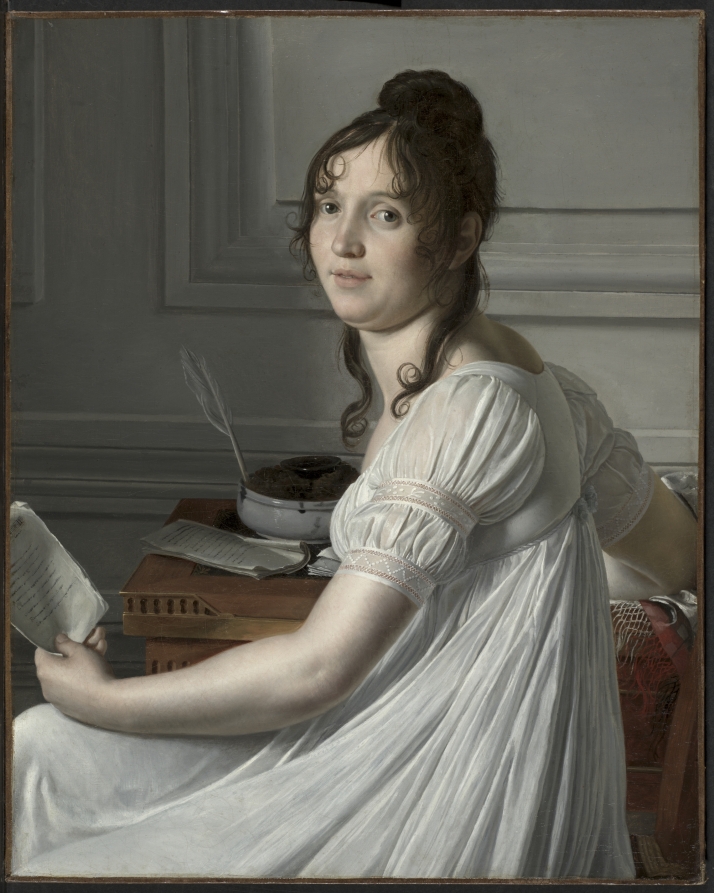
The sitter's dress deliberately evokes ancient Roman costume. However, the white muslin and straightforward cut also derives from earlier English fashions that favored simplicity in contrast to the elaborate, colorful clothing favored earlier in the 1700s. The transparency of her dress also carries political and cultural meaning: during the French Revolution in 1789, costume began to signify political allegiance, a sign of the character of the person who wore it. For women, transparency became increasingly literal, as in the sheer fabric worn by Crouzet, who came from a family of active revolutionaries.
Provenance
Sophie Crouzet, retained by, until her death in 1844.; By inheritance to her son Félix-Adolphe Crouzet.; By inheritance to his daughter Sophie Crouzet, wife of Gustave-François Bourotte.; By inheritance to their first-born son Eugène (d. 1899).; By inheritance to his brother Émile Bourotte, then by inheritance to his wife, Mme Joséphine Darte-Bourotte, Versailles.; Sold to Wildenstein & Co., New York, probably in the early 1920s.; Grace Rainey Rogers sale, Parke-Bernet Galleries, New York, 18 November 1943 (lot 51), as Jacques-Louis David, Citoyenne Crouzet.; Purchased by the CMA in 1943.
Accession Number
1943.659
Medium
oil on fabric
Dimensions
Framed: 101 x 85.5 x 12.5 cm (39 3/4 x 33 11/16 x 4 15/16 in.); Unframed: 81.2 x 65 cm (31 15/16 x 25 9/16 in.)
Classification
Painting
Credit Line
Grace Rainey Rogers Fund