Description
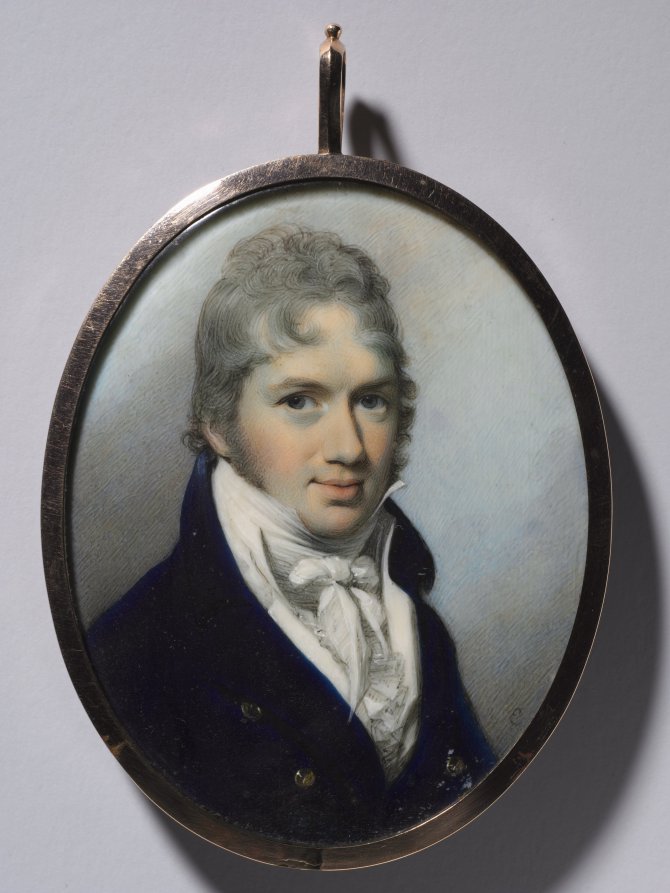
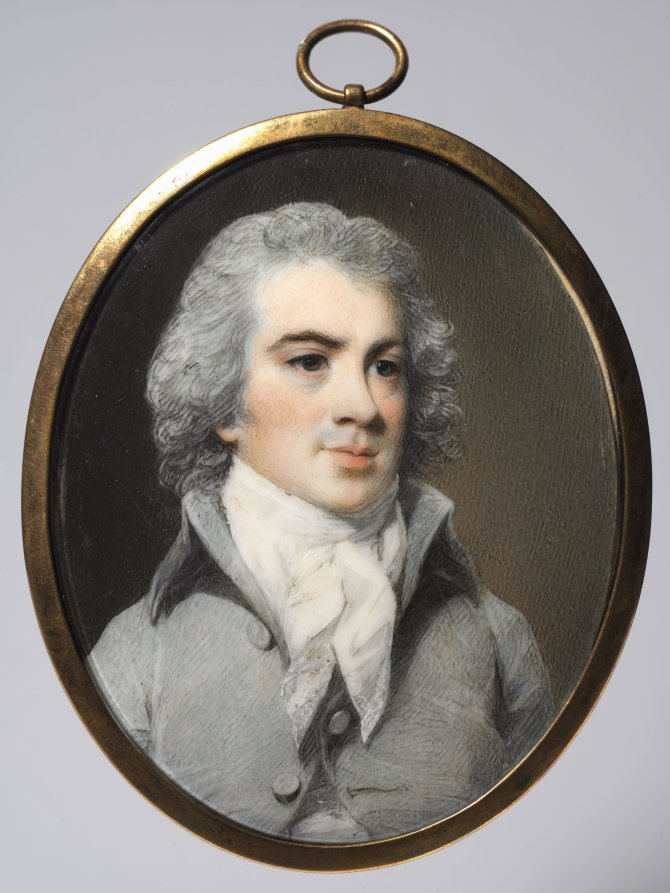
Executed around 1795, this work exhibits strong yet restrained tones. The background is painted in muted gray-browns, not the bright blue cloudy sky for which George Engleheart became known. The sitter’s position is somewhat awkward, with his shoulders nearly squared with the picture plane but his head in a three-quarter view. He wears a gray coat with fabric-covered buttons and the high collar fashionable in the 1790s. His hair is carefully delineated with dark gray brushstrokes applied over a pale gray ground. The sitter’s powdered hair is worn long, and his dark, deep-set eyes cast shadows that lend drama to the portrait. This proto-romantic sensibility is characteristic of the artist’s work between 1780 and 1795, as is its relatively modest size. Painted on ivory measuring 6.9 centimeters high, it is the smaller format of Engleheart miniatures before the turn of the century, after which the format expanded, as seen in the museum’s other two works by the artist. The portrait is unsigned, which is typical for his works of this period. The simple gold frame is original. The work was in the collection of Sir Harry Waechter, Bart., the British businessman and philanthropist, until his 1929 death at his home in Southern Rhodesia (now Zimbabwe).
Provenance
Sir Harry Waechter (1871-1929), Salisbury, Southern Rhodesia (now Harare, Zimbabwe)) (Before 1929); Leo Schidlof (1886-1966), Paris, France, sold to Edward B. Greene (By 1929-1930); Edward B. Greene (1878-1957), Cleveland, OH, gifted to the Cleveland Museum of Art (1930-1943); The Cleveland Museum of Art, Cleveland, OH (1943-)
Accession Number
1943.640
Medium
watercolor on ivory in an original gold frame
Dimensions
Framed: 7.6 x 6.2 cm (3 x 2 7/16 in.); Sight: 7 x 5.7 cm (2 3/4 x 2 1/4 in.)
Classification
Portrait Miniature
Credit Line
The Edward B. Greene Collection