Description
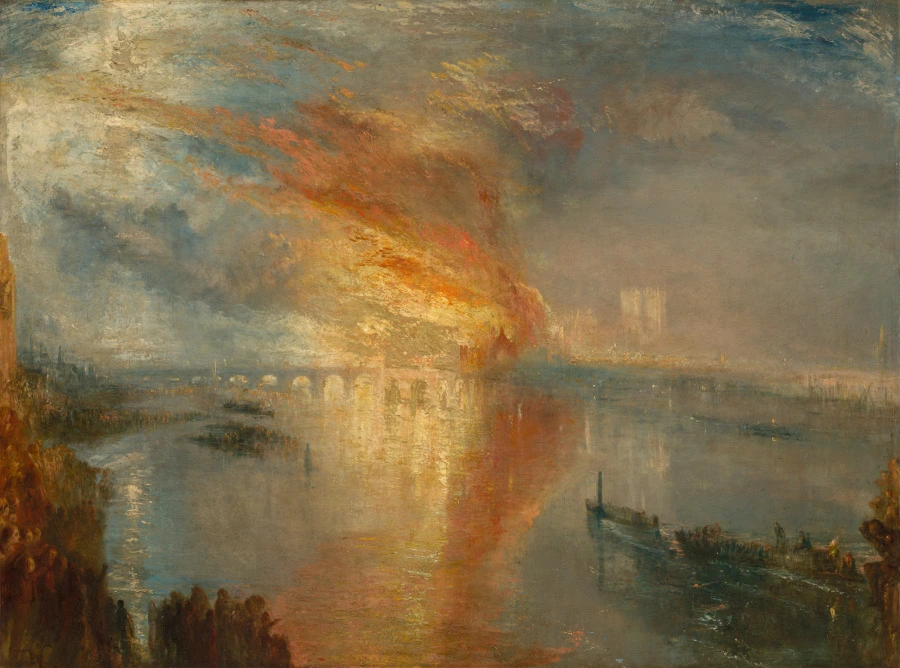
Fire consumed London’s famous Houses of Parliament on the night of October 16, 1834, and people gathered along the banks of the river Thames to gaze in awe at the horrifying spectacle. Initially, a low tide made it difficult to pump water to land and hampered steamers towing firefighting equipment along the river. The blaze burned uncontrollably for hours.
J. M. W. Turner records the struggle as the boats in the lower-right corner head toward the flames. Although Turner based the painting on an actual event, he magnified the height of the flames, using the disaster as the starting point to express man’s helplessness when confronted with the destructive powers of nature. Brilliant swathes of color and variable atmospheric effects border on abstraction.
J. M. W. Turner records the struggle as the boats in the lower-right corner head toward the flames. Although Turner based the painting on an actual event, he magnified the height of the flames, using the disaster as the starting point to express man’s helplessness when confronted with the destructive powers of nature. Brilliant swathes of color and variable atmospheric effects border on abstraction.
Provenance
Bought from the artist by John Garth Marshall [1765-1845], Headingly House, Leeds, United Kingdom, and by descent.; (Christie's, London, United Kingdom, April 28, 1888, under the name of Ponsford. (1888); Descended in the Marshall family through Victor Marshall of Mark Coniston to James Marshall.; (Leicester Gallery, London, United Kingdom, 1920, sale; but returned to owner) (1920); (Knoedler, London, United Kingdom, 1922, sold to John L. Severance) (1922); John L. Severance [1863-1936], Cleveland, OH, by bequest in 1936 to the Cleveland Museum of Art (1922-1936); The Cleveland Museum of Art, Cleveland, OH (1942-)
Accession Number
1942.647
Medium
oil on canvas
Dimensions
Framed: 123.5 x 153.5 x 12 cm (48 5/8 x 60 7/16 x 4 3/4 in.); Unframed: 92 x 123.2 cm (36 1/4 x 48 1/2 in.)
Classification
Painting
Credit Line
Bequest of John L. Severance
Tags
Painting Neoclassical & Romantic (1751–1850) Oil Painting Canvas British
Background & Context
Background Story
The Burning of the Houses of Lords and Commons, October 16, 1834, painted in 1835, is one of Turner most dramatic and most celebrated works. The painting depicts the catastrophic fire that destroyed the medieval Houses of Parliament, the flames leaping into the night sky as crowds gather on the south bank of the Thames to watch the conflagration.
Turner witnessed the fire himself, sketching it from a boat on the Thames and from the south bank. The experience of watching a great building burn provided him with a subject that combined his lifelong interests: fire, water, architecture, and the sublime power of natural and human forces.
The painting most characteristic feature is its treatment of fire as light. Turner renders the burning Parliament as a source of illumination rather than a source of destruction: the flames light the sky, reflect off the water, and illuminate the faces of the crowd with a golden radiance that transforms the disaster into a spectacle of extraordinary beauty. This treatment of fire as light reveals his essential vision: the world as energy, and all its phenomena as manifestations of a single divine force.
The crowd on the riverbank, their faces lit by the flames, are Turner most vivid rendering of the human response to the sublime. Their expressions of awe and terror, caught in the firelight, are the painting moral center: the reminder that the beauty of destruction is also its horror.
Cultural Impact
Turner Burning of the Houses of Parliament paintings created the most sublime images of urban disaster in Western art and established the conflagration as a subject that could sustain the most ambitious landscape painting. Their influence on the depiction of fire and light extended through the Impressionists to the most advanced painters of the 20th century.
Why It Matters
This painting captures Turner most radical vision: the world as energy, and beauty as the form that energy takes. The burning Parliament, reduced to a pyre of light, is both a catastrophe and a revelation - proof that the same force that builds civilizations can also destroy them.