Description
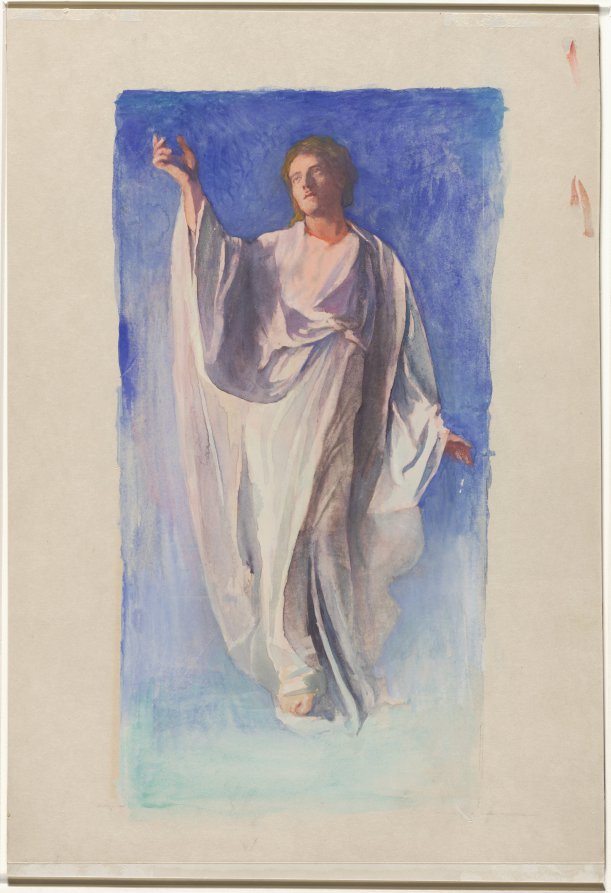
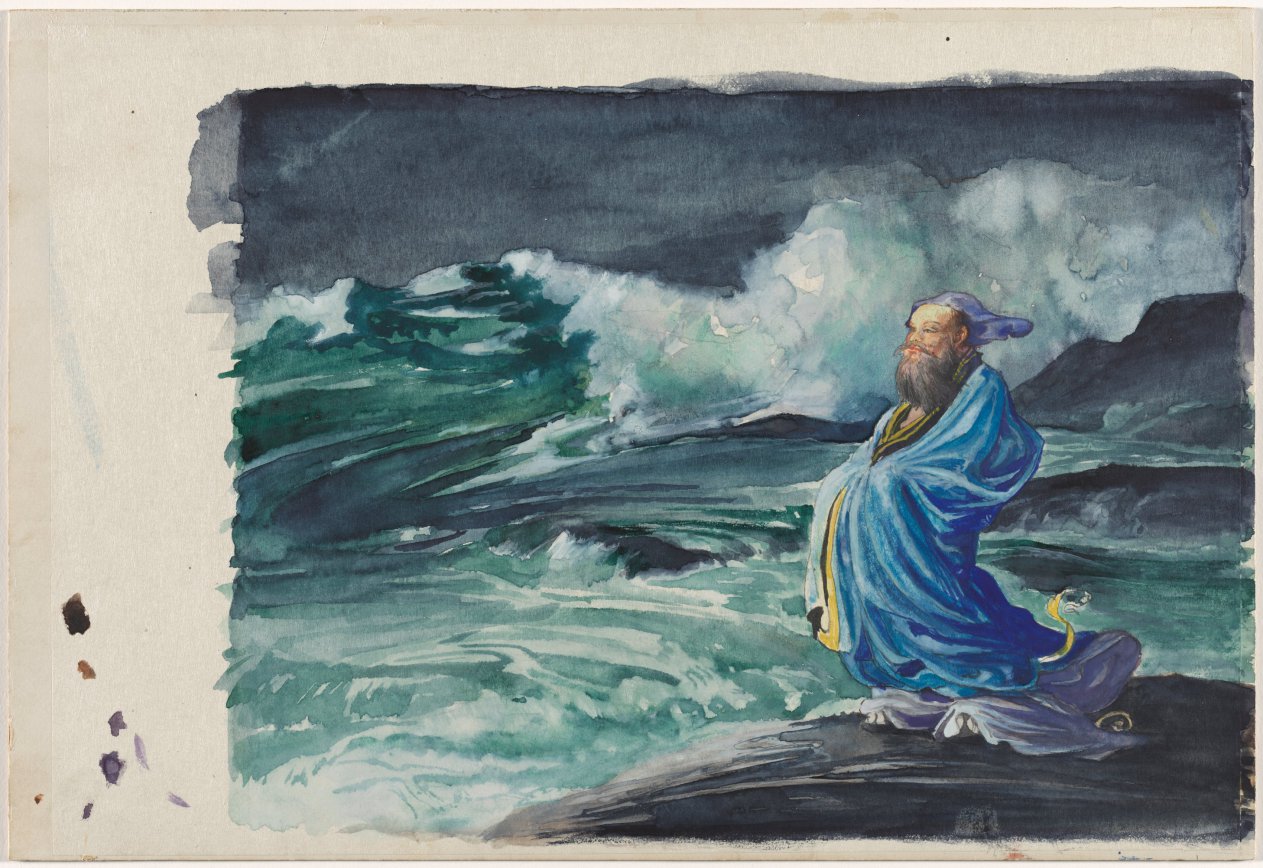
In the late 19th century, John La Farge was one of the first American artists to take a serious interest in Japanese art. This watercolor was produced after La Farge visited Japan in 1886, where he studied Daoism and painting with the writer Okakura Kakuzō (1862–1913). Here, he employed Western modeling and depth, building the water’s mass through transparent washes of light and dark blue, but also simulated the asymmetrical composition, lyrical tone, and bright blue color palette of contemporary Japanese woodblock prints. Hinting at the relationship between humans and the natural world, the ocean’s tempestuous curls echo the swirls of dense gouache in the imaginary figure’s robes, merging the figure of the “rishi” with the surging waters behind him. According to the artist's writings, “rishi” designates a powerful being who has reached immortality by following Daoist teachings. However, it is possible that La Farge misunderstood the term rishi: Resshi—the Japanese pronunciation of Liezi (列子), is a legendary Daoist philosopher who could ride the wind.
Provenance
(Doll and Richards Gallery (est. 1866), Boston, MA.) (1898-?); The Wheelwright family, Boston, MA.
Mary C. Wheelwright [1878-1958], Boston, MA, sold to The Cleveland Museum of Art, 1939. (?-1939); The Cleveland Museum of Art, Cleveland, OH. (1939-)
Accession Number
1939.267
Medium
watercolor and gouache over graphite
Dimensions
Sheet: 27.3 x 38.9 cm (10 3/4 x 15 5/16 in.); Image: 25 x 33.7 cm (9 13/16 x 13 1/4 in.); Secondary Support: 28 x 40.8 cm (11 x 16 1/16 in.)
Classification
Drawing
Credit Line
Purchase from the J. H. Wade Fund