Description
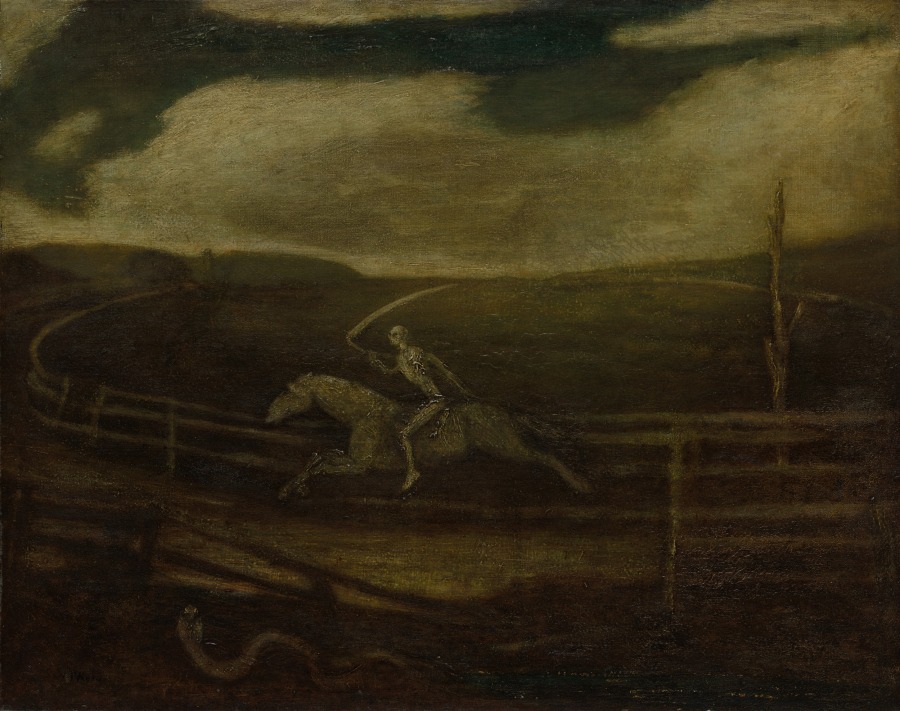
Ryder’s subject was inspired by a horse race that took place in New York during 1888. One of the artist’s friends wagered $500 on the race and then died by suicide after the horse lost. Medieval symbolism infuses the composition: death appears as a skeleton on horseback holding a scythe with which he cuts down the living, while a snake—a sign of temptation and evil—slithers in the foreground. An intense man, Ryder worked on the painting for several years and was deeply reluctant to part with it.
Provenance
Albert Pinkham Ryder [1847-1914], New York, NY, sold to Louis Lehmeier (c. 1896–1906); Louis Lehmeier, returned to the artist (1906–by 1913); Albert Pinkham Ryder, probably sold to Albert T. Sanden (After 1906–by 1913); Albert T. Sanden, New York, NY (By 1913–1924); (Ferargil Galleries, New York, NY, sold to the Cleveland Museum of Art) (1924); The Cleveland Museum of Art, Cleveland, Ohio (1928–)
Accession Number
1928.8
Medium
oil on canvas
Dimensions
Framed: 84.5 x 102 x 6.5 cm (33 1/4 x 40 3/16 x 2 9/16 in.); Unframed: 70.5 x 90 cm (27 3/4 x 35 7/16 in.)
Classification
Painting
Credit Line
Purchase from the J. H. Wade Fund
![Saint Bernard and Saint Catherine of Alexandria with the Virgin of the Annunciation [right panel]](https://api.nga.gov/iiif/e6890364-4d99-4684-a62b-5060ee3c3446/full/400,/0/default.jpg)