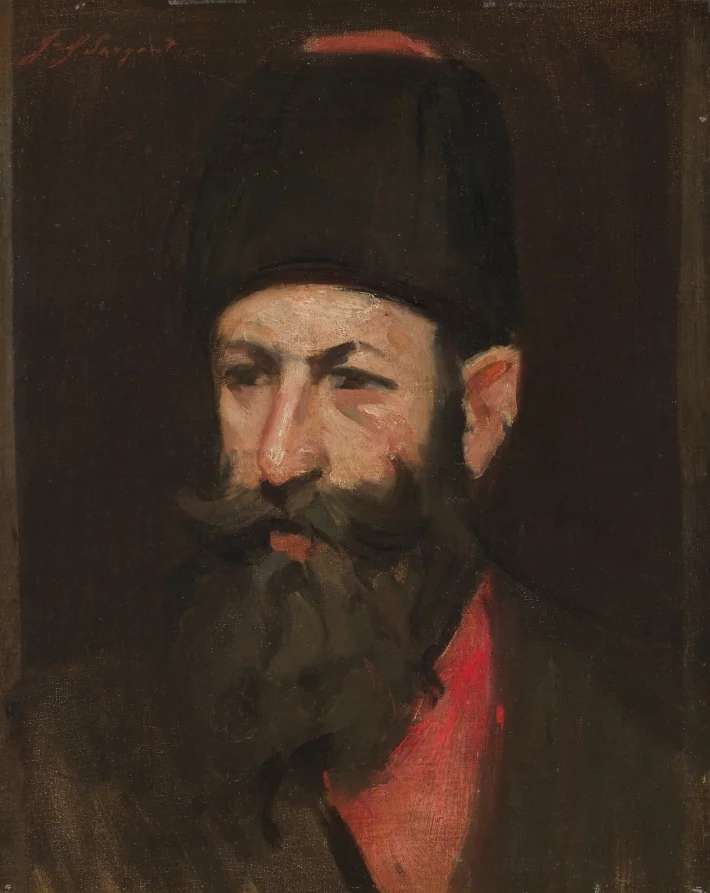
Accession Number
1927.397
Medium
oil on canvas
Dimensions
Unframed: 46.1 x 37.3 cm (18 1/8 x 14 11/16 in.)
Classification
Painting
Credit Line
Gift of Mrs. Henry A. Everett for the Dorothy Burnham Everett Memorial Collection
Background & Context
Background Story
John Singer Sargent's "The Cossack" is a striking oil on canvas portrait that captures a figure in Cossack dress, likely painted during Sargent's travels or as a studio study. Sargent (1856–1925) was the most celebrated portraitist of his generation, known for his dazzling technique and ability to capture character with seemingly effortless brushwork. Born in Florence to American parents and trained in Paris, Sargent was a cosmopolitan artist whose career spanned Europe and America. While best known for his society portraits, Sargent also produced a remarkable body of genre works, landscapes, and studies of exotic subjects. The Cossack subject reflects the 19th-century fascination with the peoples of the Russian Empire and the Caucasus region. Cossacks were romanticized in European culture as fierce, independent warrior horsemen from the steppes, and their distinctive clothing—the fur hat (papakha), the long coat (chokha), and the decorative cartridge belt—made them a visually compelling subject. Sargent's handling of the paint is characteristically bold, with thick impasto highlighting the textures of fur and fabric. The dark, neutral background focuses attention on the figure's face and costume.
Cultural Impact
Sargent's portraits of ethnic types contributed to the late 19th-century ethnographic impulse in art, reflecting both genuine curiosity about other cultures and the orientalist tendencies of the period.
Why It Matters
This oil study showcases Sargent's extraordinary facility with paint and his ability to capture not just the appearance but the presence of his subjects, transforming a costume study into a vivid encounter with a distant culture.
![Saint Bernard and Saint Catherine of Alexandria with the Virgin of the Annunciation [right panel]](https://api.nga.gov/iiif/e6890364-4d99-4684-a62b-5060ee3c3446/full/400,/0/default.jpg)