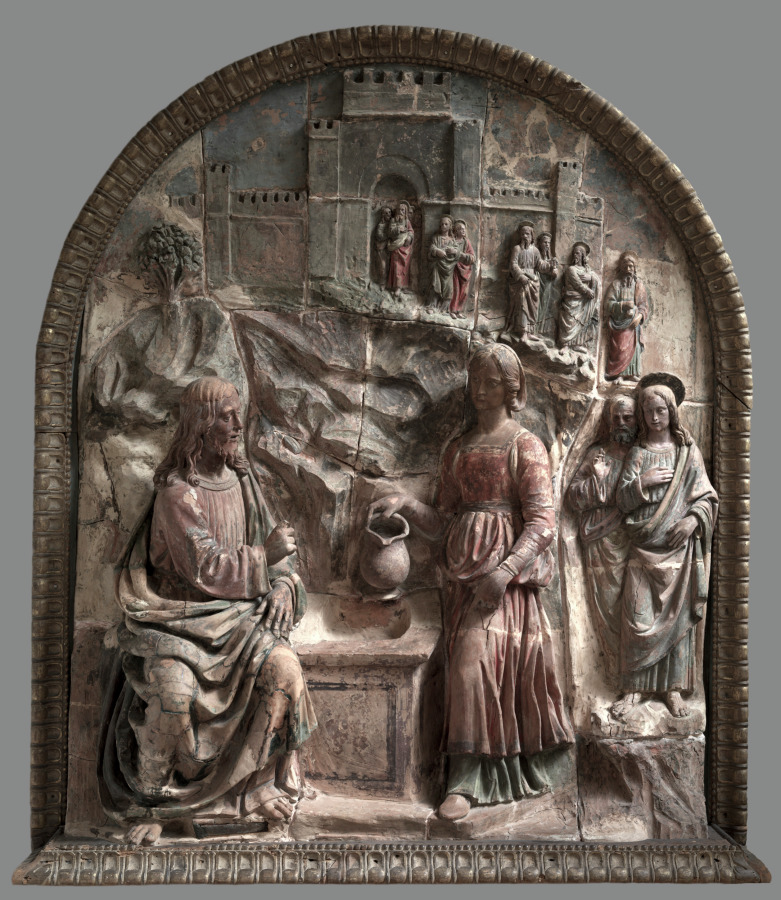
Description
This sculptural relief belongs to a large series made for the Franciscan friary of San Vivaldo (founded 1350) in the Tuscan hills southwest of Florence. The friary was enlarged between 1500 and 1530 when 32 chapels were built, each dedicated to an incident in the life or Passion of Christ. San Vivaldo became a recognized pilgrimage site thematically linked to the holy sites of Jerusalem. Each single chapel at San Vivaldo was embellished with colorful terracotta sculptures produced by the Della Robbia workshop in Florence. This relief representing Christ and the Samaritan Woman was originally installed within the Chapel of the Samaritan Women. Over time the chapel fell into disrepair and eventually became the friar's wash house. The sculpture was sold by the friary in the early 1900s to fund repairs to the various chapels. The fine modeling of the heads of Christ and the Apostles and of the landscape masses gives an indication of the original quality of this badly damaged relief sculpture. The animation of the faces and complexity of the composition suggest that it was made under the supervision of Giovanni rather than by some lesser member of the Della Robbia workshop.
Provenance
Sacro Monte di San Vivaldo, Tuscany, Italy, sold to Elia Volpi (-1911/12); (Elia Volpi (1858–1938), Florence, Italy) (1911/12-); (Maurice (1879-1950) and Raphaël (1887-1963) Stora, Paris, France) (By 1922); Samuel Mather [1851-1931] Cleveland, OH, by gift to the Cleveland Museum of Art. (-1922); The Cleveland Museum of Art, Cleveland, OH (1922-)
Accession Number
1922.210
Medium
polychromed terracotta
Dimensions
Overall: 221 x 177.8 x 27.9 cm (87 x 70 x 11 in.)
Classification
Sculpture
Credit Line
Gift of Samuel Mather