Description
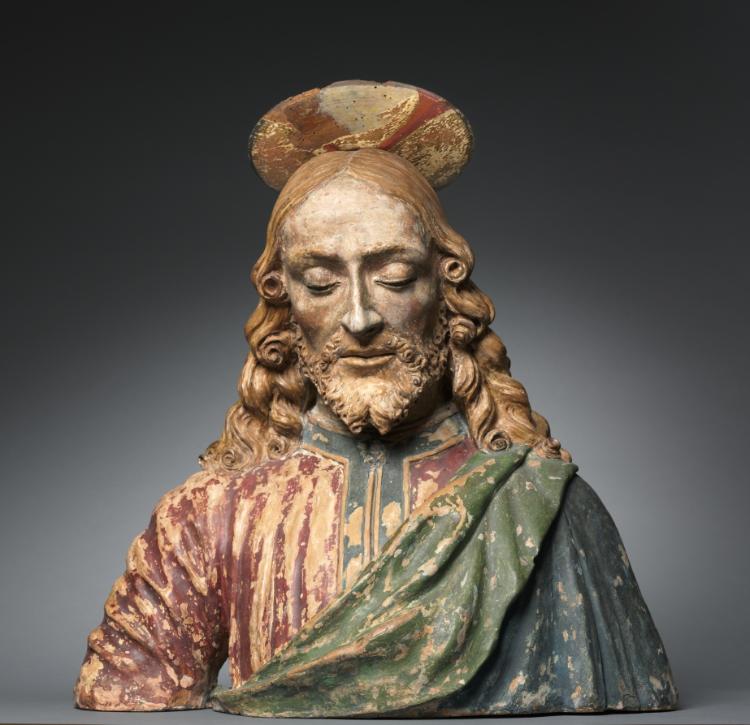
In the late 1400s Andrea del Verrochio set up a large workshop where he and his assistants reproduced copies of his sculpture and other works for a middle-class market. Originality was not the objective; in fact, most people were only interested in purchasing replicas of well-known works. This sculpture was modeled after Verrocchio's Christ figure in the bronze sculpture group Christ and St. Thomas at Orsanmichele in Florence, Italy. The medium of terracotta, which was cheaper than bronze or marble, made it possible to offer copies at a reasonable price. Additionally, workshop practices reduced the cost of the work by reducing labor time. Assistants were usually responsible for the shaping of the torso and garments, while Verrocchio was often in charge of executing the facial features and hair. In this sculpture the torso is out of proportion, and the general discrepancy in quality between the parts of the sculpture is due to the fact that it is a workshop production. Given that the facial features are so well executed and the statue retains a stirring motional quality, a trademark of Verrocchio's style which artists found hard to duplicate, it is probable that this sculpture was made in Verrocchio's studio, possibly even with active involvement by the artist on the head.
Provenance
Harold Woodbury Parsons, 1882-1967 (New York, New York), sold to the Cleveland Museum of Art, 1921.
Accession Number
1921.956
Medium
painted terracotta and wood
Dimensions
Overall: 57.2 x 53.3 x 29.2 cm (22 1/2 x 21 x 11 1/2 in.)
Classification
Sculpture
Credit Line
Charles W. Harkness Endowment Fund