Description
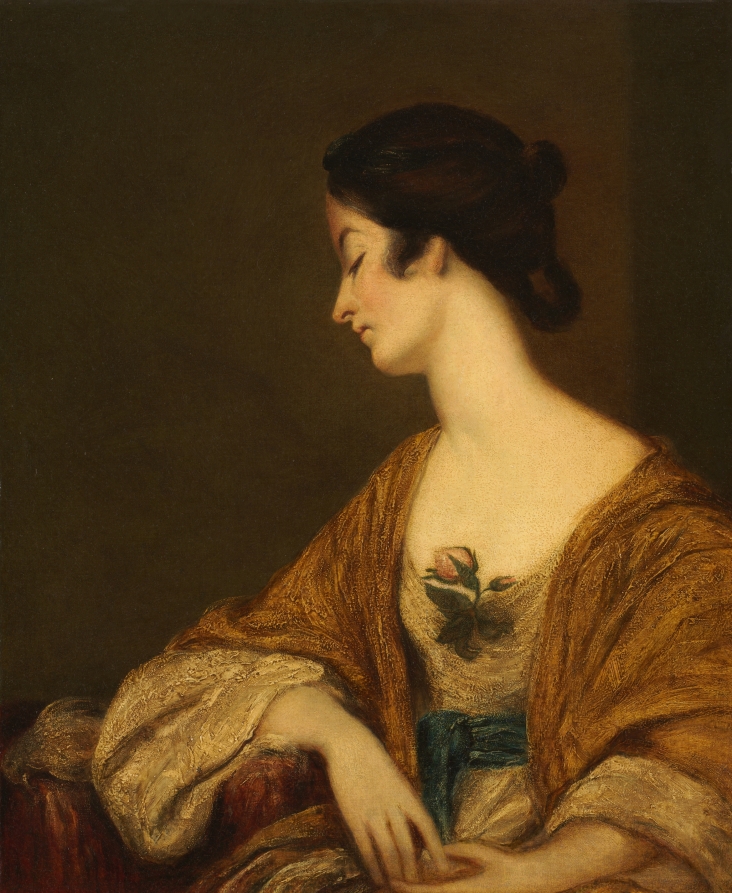
Given to the Cleveland Museum in 1920 by the collector Jeptha H. Wade, this painting was thought to be an authentic work by Joshua Reynolds. However, after considerable study, the museum attributed it to a follower of Reynolds working in a similar style around the same time. This portrait depicts the wife of the captain (and later admiral) George Collier. The artist draws an analogy between this woman and Lesbia, a married woman who provided much artistic inspiration for the Roman poet Catullus (c. 84–c. 54 BC). The poet's writings document a love affair with Lesbia, and one poem in particular documents the death of the woman's beloved pet sparrow. The viewer can barely see the sparrow in this painting, since it lies on a table partially obscured by her right elbow. The muted colors evoke a sense of melancholy as the woman mourns with her head turned away from the viewer.
Provenance
(possibly Mary Horneck Gwynn, sister in law of the sitter (1823); Sir William W. Knighton, Hampshire (1864, Christie's, London sale 21 May, 1885, no. 457; Mrs. Adelaide Ross; J. H. Wade, Cleveland (by 1913); Possib;y Mrs. George Collier, possibly by inheritance to her sister-in-law, Mary Horneck Gwynn,; Possibly Mary Horneck Gwynn; William Wellesley Knighton, 2nd Bt., 1836-1855 (London, England, and Blendworth Lodge, Hampshire, England), upon his death, held in trust by the estate; Estate of William Wellesley Knighton, sold, Christie's, London, May 21, 1885, lot 457; Mrs. Adelaide Ross (Stachelberg, New York); Jeptha Homer Wade, 1857-1926 (Cleveland, Ohio), by gift to the Cleveland Museum of Art, 1920.
Accession Number
1920.514
Medium
oil on canvas
Dimensions
Framed: 112 x 101 x 12 cm (44 1/8 x 39 3/4 x 4 3/4 in.); Unframed: 80 x 67.3 cm (31 1/2 x 26 1/2 in.)
Classification
Painting
Credit Line
Gift of J. H. Wade
![Saint Bernard and Saint Catherine of Alexandria with the Virgin of the Annunciation [right panel]](https://api.nga.gov/iiif/e6890364-4d99-4684-a62b-5060ee3c3446/full/400,/0/default.jpg)