Accession Number
1916.931
Medium
Ink and color on paper
Dimensions
Overall: 38.8 x 55 cm (15 1/4 x 21 5/8 in.)
Classification
Painting
Credit Line
Gift of Mrs. Henry S. Upson
Tags
Painting Baroque (1600–1750) Ink Paper
Background & Context
Background Story
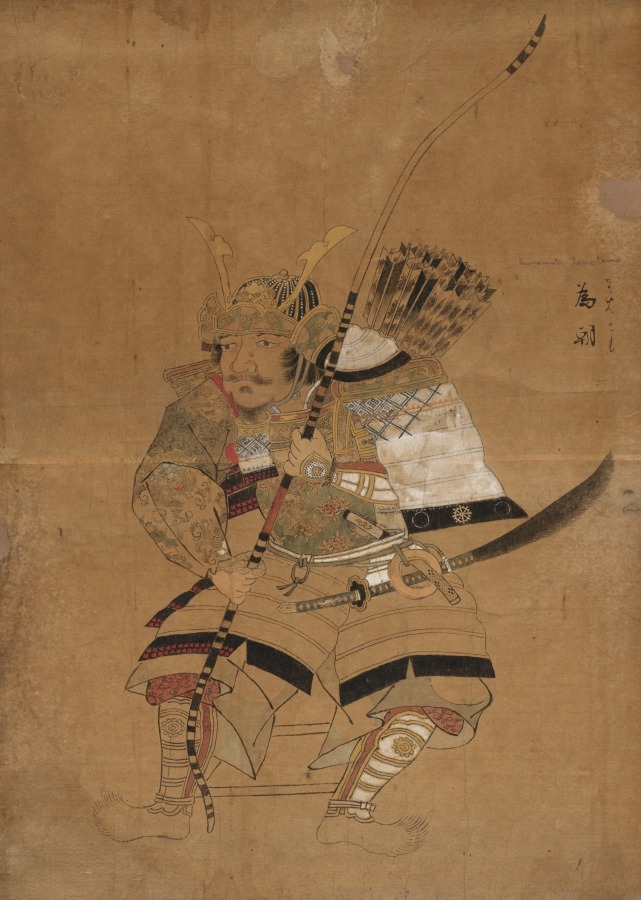
This sketch model for portraits of Minamoto Tametomo is a Japanese work from the Edo period (1615-1868), relating to one of the most legendary warriors of the late Heian period. Minamoto no Tametomo (1139-1170) was a samurai renowned for his extraordinary archery skills, his rebellious spirit, and his dramatic life story that ended in suicide rather than capture during the Hogen Rebellion. In Japanese cultural memory, Tametomo became a figure of outsized legend: tales grew around his prodigious strength, his enormous bow, his exile to the island of Oshima, and the apocryphal story that he traveled to Okinawa and became king there. During the Edo period, the Tokugawa shogunate promoted the martial virtues of the samurai class as part of its ideology of social order, and portraits of legendary warriors like Tametomo served both as objects of admiration and as embodiments of bushido values. Sketch models, known as hakohitsu or shita-e in Japanese printmaking traditions, were preparatory works used by artists to establish the composition and expression of a final portrait before committing it to woodblock or final painted form. The creation of a sketch model specifically for portraits of Tametomo suggests that the artist was working on a series of warrior portraits, a popular genre in Edo-period art. Such series celebrated the martial heritage of Japan's past while reinforcing the social values of the present. The rough, expressive quality of a sketch model often reveals the artist's initial creative impulse more directly than the polished final work, offering a glimpse into the artistic process behind the mythologization of Japan's warrior heroes.
Cultural Impact
Sketch models for warrior portraits illuminate the artistic process behind Edo-period mythologization of samurai heroes. The cult of warrior figures like Tametomo served the Tokugawa regime's ideological project of promoting martial virtue and social hierarchy, while also satisfying popular fascination with heroic tales from Japan's warrior past.
Why It Matters
This sketch model reveals both the artistic process of Japanese portrait production and the cultural practice of venerating samurai heroes during the Edo period, when warrior legends served political and social functions.