Provenance
The artist [1900-1984]; purchased c. 1975 by Arthur M. Bullowa, New York; gift 1991 to NGA.
Accession Number
1991.143.2
Medium
oil on canvas
Dimensions
overall: 127 x 91.5 cm (50 x 36 in.) | framed: 147.8 x 112.4 x 4.4 cm (58 3/16 x 44 1/4 x 1 3/4 in.)
Classification
Painting
Credit Line
Gift of Arthur M. Bullowa, in Honor of the 50th Anniversary of the National Gallery of Art
Tags
Painting Contemporary (after 1950) Oil Painting Canvas American
Background & Context
Background Story
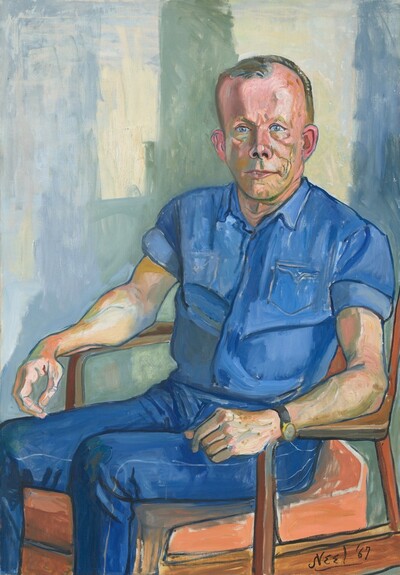
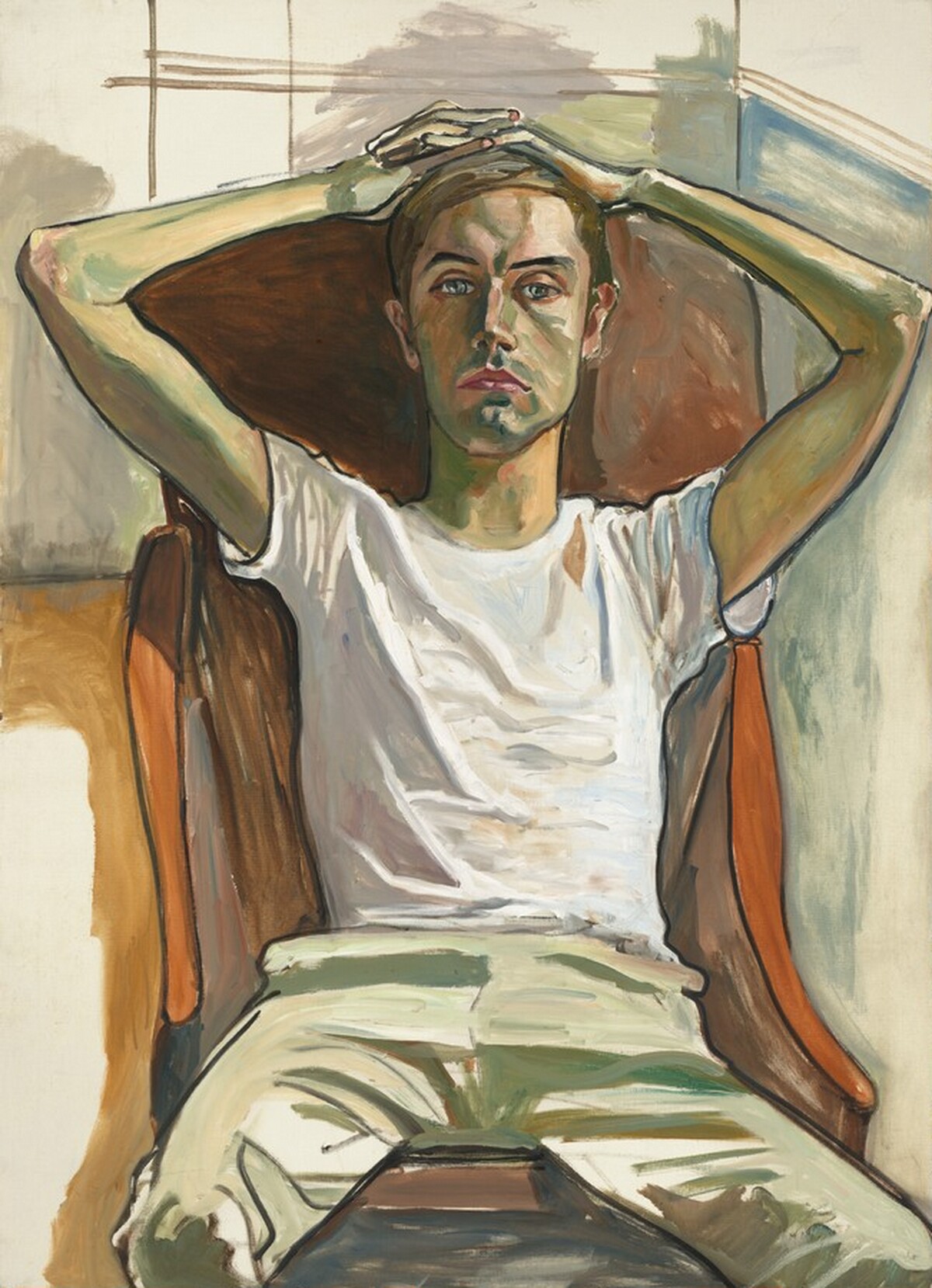
Alice Neel's "Hartley" (1966) is a portrait of the artist's second son, Hartley, painted when Neel was 66 years old and at the height of her powers. The painting depicts Hartley as a young man — thoughtful, somewhat reserved, his body filling the canvas with a physical presence that Neel's bold, unflinching brushwork makes impossible to ignore. The portrait is one of several Neel painted of her children and grandchildren, forming an intimate visual autobiography that spans decades of her life.
Neel (1900–1984) is now recognized as one of the great portrait painters of the twentieth century, but this recognition came late. For much of her career, she worked in obscurity, painting portraits of friends, neighbors, and fellow artists in a style that ran counter to every dominant tendency of her era. While the art world embraced Abstract Expressionism, Pop Art, and Minimalism, Neel persisted in painting people —specifically, people painted with a psychological intensity that revealed more about their inner lives than they might have wished to reveal.
The story of Neel's relationship with her children is inseparable from her art. In 1930, her first husband destroyed dozens of her paintings and left with their daughter, Isabetta, who was subsequently raised by relatives in Cuba. Neel's second son, Hartley, was born in 1941 to Neel and her partner, the photographer Sam Brody. In a devastating echo of her first loss, social pressures and economic hardship led Neel to place the infant Hartley with a foster family for several years. Neel eventually regained custody, but the wound of that separation remained raw, and it permeates the portraits she painted of Hartley throughout his life.
In this 1966 portrait, Hartley appears as a young man seated in a chair, his expression combining warmth with a certain wariness. Neel's characteristic approach — the boldly outlined forms, the expressive color in the flesh tones, the deliberately awkward pose, the background rendered in a contrasting color — serves not to idealize but to humanize. She paints her son as she sees him, with love but without sentimentality. The painting's power lies precisely in Neel's refusal to prettify or soften: every vulnerability, every complexity of their relationship, is present in the brushwork.
Cultural Impact
Neel's insistence on figurative painting during the era of abstraction, and her unflinching portrayal of the human body in all its imperfection, made her a feminist icon and a model for generations of artists who refused to choose between formal ambition and human content.
Why It Matters
"Hartley" is a portrait that carries the weight of an entire relationship — mother and son, artist and subject — rendered with the psychological depth and formal daring that made Alice Neel one of the most important portrait painters of the twentieth century.