Description
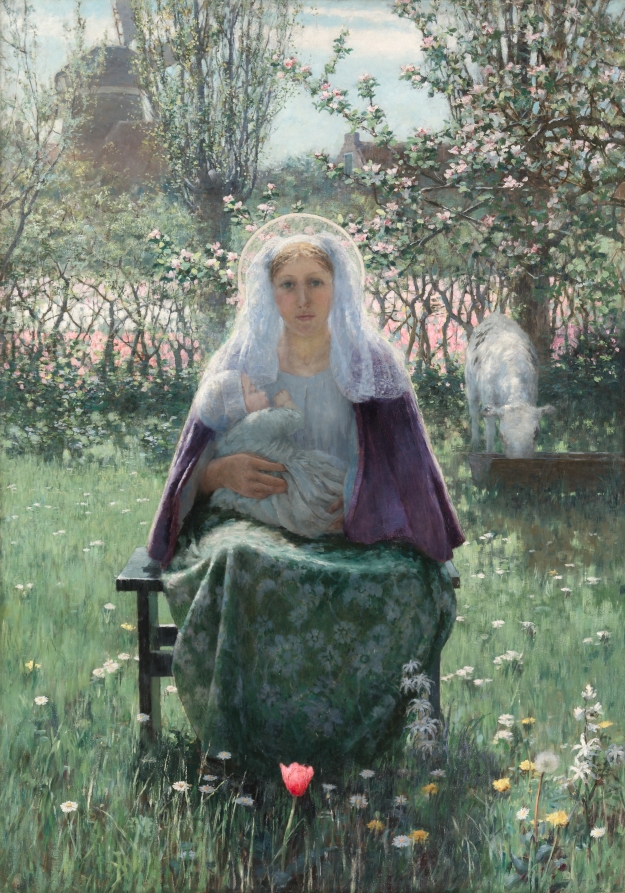
George Hitchcock decided to study art in Paris after practicing law for five years. He eventually settled in Holland and painted this Dutch peasant mother holding her baby and posing formally in a garden. Hitchcock was a visionary painter fascinated by the power of faith. But, like with many of his paintings, both the title and the scene here remain ambiguous, being neither clearly religious nor clearly secular. Early critics praised the work for its technical sophistication and representation of maternal tenderness, but they questioned its religious merit. Other reviewers, however, recognized religious symbolism throughout the painting. The mother's lacy headdress can represent a halo. The apple tree suggests the lost Eden, recovered through the birth of the child. The young bullock hints to the future sacrifice of Christ, and the prominent red tulip at the feet of the figures symbolizes the cup of sorrow. This painting's religious ambiguity exemplifies the 19th-century struggle to bring faith to terms with technical, philosophical, and scientific advances, namely Darwinism. Left to search for meaning in life and a spiritual identity, many artists, like Hitchcock, looked to women and nature for a link to the divine.
Provenance
purchased from Boussod-Valadon in 1893 by Mr. J.H. Wade
Accession Number
1916.1057
Medium
oil on canvas
Dimensions
Unframed: 160.3 x 112 cm (63 1/8 x 44 1/8 in.)
Classification
Painting
Credit Line
Gift of Mr. and Mrs. J. H. Wade