Provenance
Edward Ladd Betts [d. 1695], England.[1] M. Belinarde, 1785.[2] Alfred and Jacques Pereire, Paris, by 1936; Mme. I. P[ereire]; (her sale, Galerie Jean Charpentier, Paris, 4 June 1937, no. 22, as _Le Roi boit!_);[3] Guy Stein, Paris. Baron Alex. Gendebien, Brussels, in 1937;[4] consigned c. 1939 for Baron Robert Gendebien [1885-1954] by Eric-Emil Lyndhurst, Brussels, to (Firma D. Katz, Dieren, The Netherlands); probably sold to (P. Smit van Gelder, Antwerp); sold to (J. Kalb); sold 12 February 1941 to (Goudstikker firm, Amsterdam); sold 11 December 1941 to Professor Hoffmann, Munich; Baron Robert Gendebien, Brussels, 1955. Eric-Emil Lyndhurst, Brussels, 1955.[5] (Kunsthandel Gebr. Douwes, Amsterdam), 1955.[6] (sale, Sotheby's, London, 10 July 1963, no. 42); Mrs. Pethick.[7] Mrs. M. Polak, New York.[8] (Kunsthandel Gebr. Douwes, Amsterdam), in 1964. Dr. Heinrich Becker, Dortmund, by 1967;[9](Schaeffer Galleries, New York); purchased 3 February 1972 by NGA.
[1] The painting is inscribed on the reverse "E'd Ladd Betts, Esq." This is probably Edward Betts, a famous English physician, who died on 27 April 1695.
[2] John Smith, _A Catalogue Raisonné of the Works of the Most Eminent Dutch, Flemish and French Painters_, 9 vols., London, 1929-1942: 3(1831):334, no. 276.
[3] The painting could possibly have been in the collection of the Pereire family in the nineteenth century. During that period two Pereire brothers, Emile (1800-1875) and Isaac (1806-1880), played essential roles in France by pioneering railway transport and making innovations in investment banking and credit procedures. They were major collectors and shared an elaborate mansion on the Faubourg Saint-Honoré, where the collection was displayed. It was largely dispersed at public sales in 1868 and 1872. Their descendants Alfred and Jacques Pereire lent the painting to a 1936 exhibition in Paris. The 1937 auction catalogue identifies the seller as "Madame I.P.," although she was known to be Madame Isaac Pereire. On the family and their collection, see: M. Castille, _Les frères Pereire_, Paris, 1961; W. Bürger, "Galerie de MM. Pereire," _Gazette des Beaux-Arts_ XVI (1864): 193-213, 297-317; Francis Haskell, _Rediscoveries in Art: Some Aspects of Taste, Fashion and Collecting in England and France_, Ithaca, 1976: 83-86; Albert Boime, "Entrepreneurial Patronage in Nineteenth Century France," in _Enterprise and Entrepreneurs in Nineteenth- and Twentieth-Century France_, ed. Edward C. Carter II et al., Baltimore and London, 1976: 142-146; _Les donateurs du Louvre_, Paris, 1989: 289; Pierre Rosenberg, "La donation Pereire," _La Revue du Louvre et des Musées de France_ 25, no. 4 (1975): 259.
[4] The 1964 Gebr. Douwes exhibition catalogue lists a Baron Alex. Gendebien as the owner of the painting in 1937. According to correspondence with the Inspectie Cultuurbezit of the Netherlands and copies of documents provided by the Dutch State Archives, a Baron Robert Gendebien owned the painting in 1939 and was involved in its restitution after it was confiscated during World War II (see note 5). The relationship between Alex. and Robert Gendebien, though obviously familial, is unclear.
[5] A note on Witt Library fiche no. 13.365 indicates that the painting was "stolen from Belgium, 1939/1945." Although the collection of Eric-Emil Lyndhurst, a Jewish collector and dealer, was confiscated by the Nazi Einstazstab Reichsleiter Rosenberg (ERR) in 1943, this painting does not appear on the list of his collection compiled at that time. According to his statement of 23 July 1948, "[S]ome months before the outbreak of war in 1939, [he] handed over to Mr. Nathan Katz (of the Firm D. Katz, Dieren) [the Teniers painting] belonging to Baron Robert Gendebien for sale." Lyndhurst learned from Katz that the painting had been taken by the Germans during the war. After passing through Katz, Smit van Gelder, the Nazi-controlled Goudstikker firm, Kalb, and Hoffmann (probably Heinrich Hoffmann [1885-1957], Adolf Hitler's photographer) the painting made its way into Hitler's possession. The records of the Munich Central Collecting Point indicate that after the war the painting was recovered at Alt Ausee and restituted to the Netherlands on 15 April 1946 (Munich property card #2588/Aussee 1932; Dutch Receipt for Cultural Objects No. 10a, item no. 34, copies in NGA curatorial files). The painting arrived in the Netherlands on 28 May 1946. Although it is unclear to whom the painting was returned by the Dutch authorities, Robert Gendebien was assumed to be the rightful owner and was involved in the restitution. After its return, he may have again put the painting on consignment to Lyndhurst, who, according to the 1964 Gebr. Douwes exhibition catalogue, was in possession of it in 1955. See the letter dated 9 December 1999 from the Inspectie Cultuurbezit of The Netherlands, and copies of documents from the Stichting Nederlands Kunstbezit, archive no. 267, sent 4 January 2000 by the Dutch State Archives, in NGA curatorial files.
[6] According to a handwritten notation on a photograph in the Rubenianum in Antwerp.
[7] The Sotheby's auction report lists the purchaser of the painting as a Mrs. Pethick. Her name, however, does not appear in any other provenance listing. Perhaps she was an agent for a dealer or private collector.
[8] According to the catalogue of the 1964 Gebr. Douwes exhibition. In a letter of 30 January 1985 from Mrs. H.S. Schaeffer of Schaeffer Galleries, Inc., in NGA curatorial files, Mrs. Polak is listed as living in Sarasota.
[9] See Fritz Rolf, _Sammlung Becker_, Dortmund, 1967: no. 86; in this entry the 1936 exhibition at the Pavillon de Marsan, which included the painting, is incorrectly listed as being at the Pavillon de Marsau in 1946.
Accession Number
1972.10.1
Medium
oil on panel
Dimensions
overall: 47.2 x 69.9 cm (18 9/16 x 27 1/2 in.) | framed: 67.3 x 90.2 cm (26 1/2 x 35 1/2 in.)
Classification
Painting
Credit Line
Ailsa Mellon Bruce Fund
Tags
Painting Baroque (1600–1750) Oil Painting Panel Painting Flemish
Background & Context
Background Story
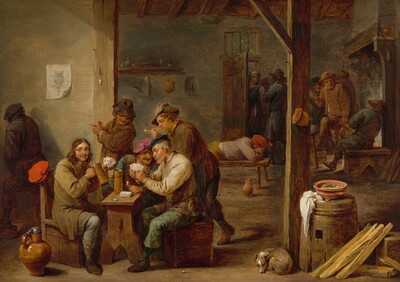
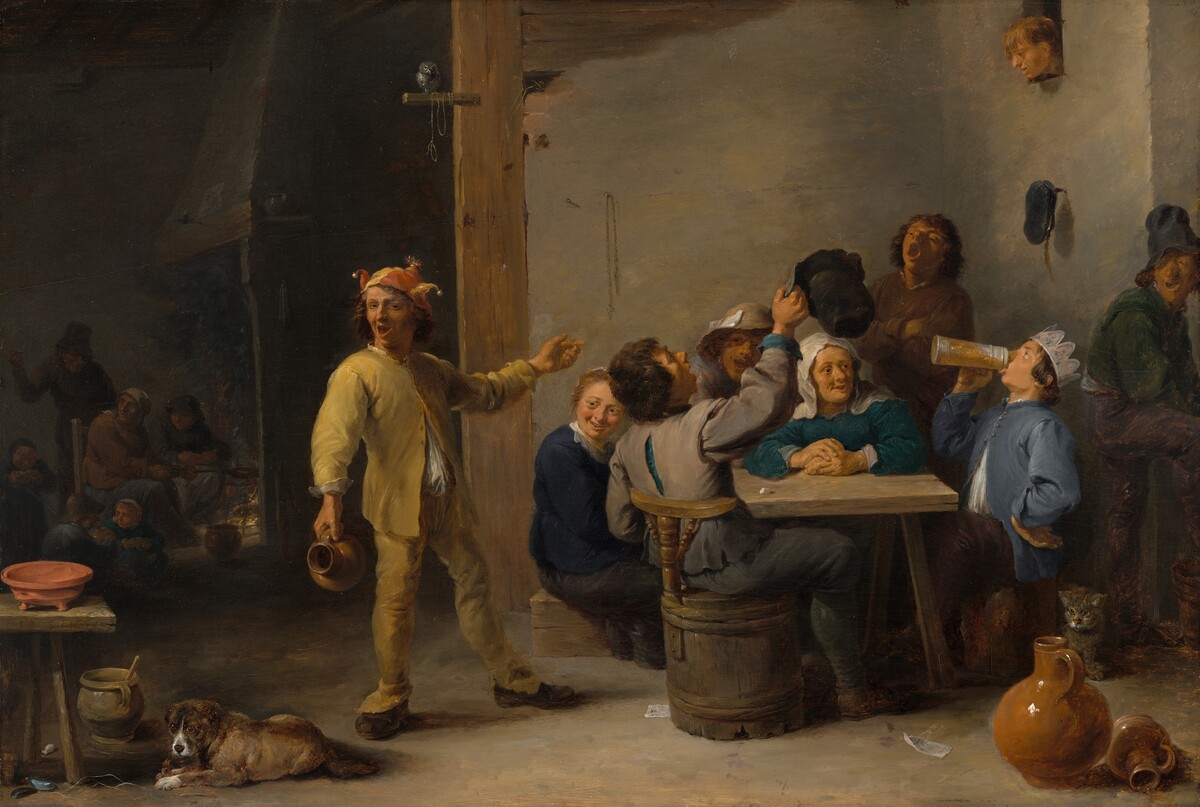
David Teniers the Younger (1610-1690) was the most celebrated Flemish genre painter of the 17th century, and this early work from 1635 shows him already mastering the subject that would make his reputation: peasants celebrating a traditional holiday. Twelfth Night (January 6th, the Feast of the Epiphany) was one of the major winter festivals in Flanders, and Teniers' depiction of its celebration includes the traditional elements — feasting, drinking, and the crowning of the Twelfth Night king (the person who finds the bean in the cake). The painting's early date and confident execution demonstrate that Teniers' mastery of peasant genre was already fully developed by his mid-twenties.
Cultural Impact
Twelfth Night celebrations were a common subject in Flemish painting, but Teniers' version is distinguished by its compositional sophistication and its refusal to moralize. Where other painters used peasant festivals as occasions for moral commentary on gluttony or drunkenness, Teniers presents the celebration as a genuine social event with its own rituals, hierarchies, and pleasures. The Twelfth Night king, crowned with paper and presiding over the feast, is treated with the same respect that a court painter would give to a real monarch.
Why It Matters
Peasants Celebrating Twelfth Night is the young Teniers already fully formed: the festival is observed with empathy and compositional skill, the peasants are individuals rather than types, and the crowning of the bean-king is treated as genuine social ritual rather than rustic comedy. The painting announces a major talent.