Description
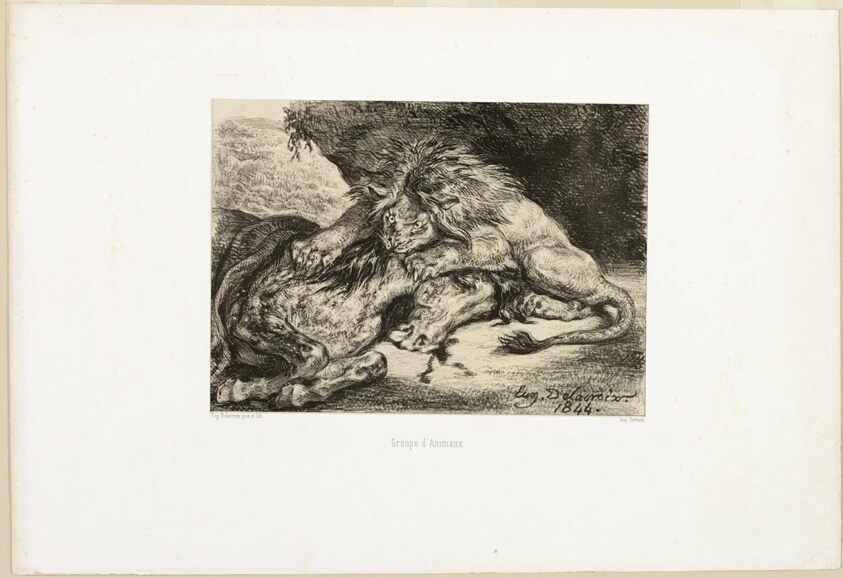
Man and beast intertwine to form a single writhing body in this emotionally charged depiction of a lion attacking a horse and its rider. Through short, energetic brushstrokes and carefully manipulated contrasts of light and shadow, Eugène Delacroix imbued this imagined scene with action and drama. While many artists of the period explored the theme of man versus nature, depictions of Arab men entangled with wild animals served a specific propagandistic function, justifying the brutality of French colonial rule by depicting its subjects as violent and inhuman.
Provenance
Baron Michel de Trétaigne, by 1864 [lent by him to Paris 1864]; his sale Hôtel Drouot, Paris, February 19, 1872, lot 19 as Cavalier arabe attaqué par un lion for 17,000 francs [price according to an annotated copy of the sale catalogue in the Rijksbureau voor Kunsthistorische Documentatie, The Hague]. Febvre [according to Moreau 1873, Febvre purchased the painting from the Trétaigne sale]. Boucheron, by 1885 [lent to Paris 1885]. R. Austin Robertson (New York?), by 1892; his estate sale American Art Association, New York, April 8, 1892, lot 127 as Arab cavalier attacked by a Lion for $6,350 to Potter Palmer [price according to an annotated copy of the sale catalogue in the American Antiquarian Society, Worcester, Massachusetts; buyer according to The Critic 1892]; Potter Palmer (died 1902), Chicago; his widow, Bertha Honoré Palmer (died 1918); by descent to their sons Honoré and Potter Palmer; given to the Art Institute, 1922.
Accession Number
81503
Medium
Oil on panel
Dimensions
43.9 × 38.1 cm (17 1/4 × 15 in.); Framed: 63.9 × 55.3 × 8.3 cm (25 1/8 × 21 3/4 × 3 1/4 in.)
Classification
Painting
Credit Line
Potter Palmer Collection
Background & Context
Background Story
This small panel from 1849–50 is one of Delacroix's most concentrated studies of animal ferocity, showing a lone Arab horseman struggling against a lion attack in a composition that compresses the epic scale of his hunting scenes into an intimate format of barely 44 × 38 centimeters. The painting belongs to the period immediately following Delacroix's 1847 journey to North Africa, when memories of the Moroccan landscape and its inhabitants were still fresh and could be summoned with the vividness of immediate experience. The horse rears in terror, its rider clinging to the saddle with one hand while raising a weapon with the other, the whole scene frozen at the climactic moment of confrontation. Delacroix's brushwork on panel is tighter and more controlled than on his larger canvases: the small scale demands precision, and every stroke contributes to the narrative clarity that the composition requires. The palette is warm and sun-bleached—pale ochres, dusty browns, and the tawny gold of the lion's coat—creating an atmosphere of North African heat that makes the violence feel inevitable rather than exceptional. The painting also reflects Delacroix's ethnographic interests: the horseman's costume, his weapon, and the saddle are all rendered with the documentary care that the artist brought to his Moroccan sketches. Yet the work transcends ethnography through its emotional intensity: the horseman's isolation, the lion's relentless power, and the desert emptiness that surrounds them create a drama of man against nature that echoes the philosophical concerns of Romanticism. Art historians have linked this panel to the broader tradition of the animal fight in European art, from the Roman mosaics of North Africa to Rubens's hunting scenes, noting that Delacroix's treatment is more intimate, more focused on individual struggle than on collective action.
Cultural Impact
This small North African panel compressed epic hunting drama into intimate scale, using precise panel brushwork and sun-bleached palette to make individual struggle feel philosophically inevitable.
Why It Matters
It matters because Delacroix made a man fight a lion in forty-four centimeters—proving that the whole desert could fit on a panel if the terror was concentrated enough.