Provenance
Dorothy and Roy [1923-1997] Lichtenstein, New York; gift (partial and promised) 1990 to NGA; gift completed 1999.
Accession Number
1990.41.1
Medium
oil on canvas
Dimensions
overall: 121.9 x 175.3 cm (48 x 69 in.) | framed: 123.5 x 176.9 x 5.1 cm (48 5/8 x 69 5/8 x 2 in.)
Classification
Painting
Credit Line
Gift of Roy and Dorothy Lichtenstein in Honor of the 50th Anniversary of the National Gallery of Art
Background & Context
Background Story
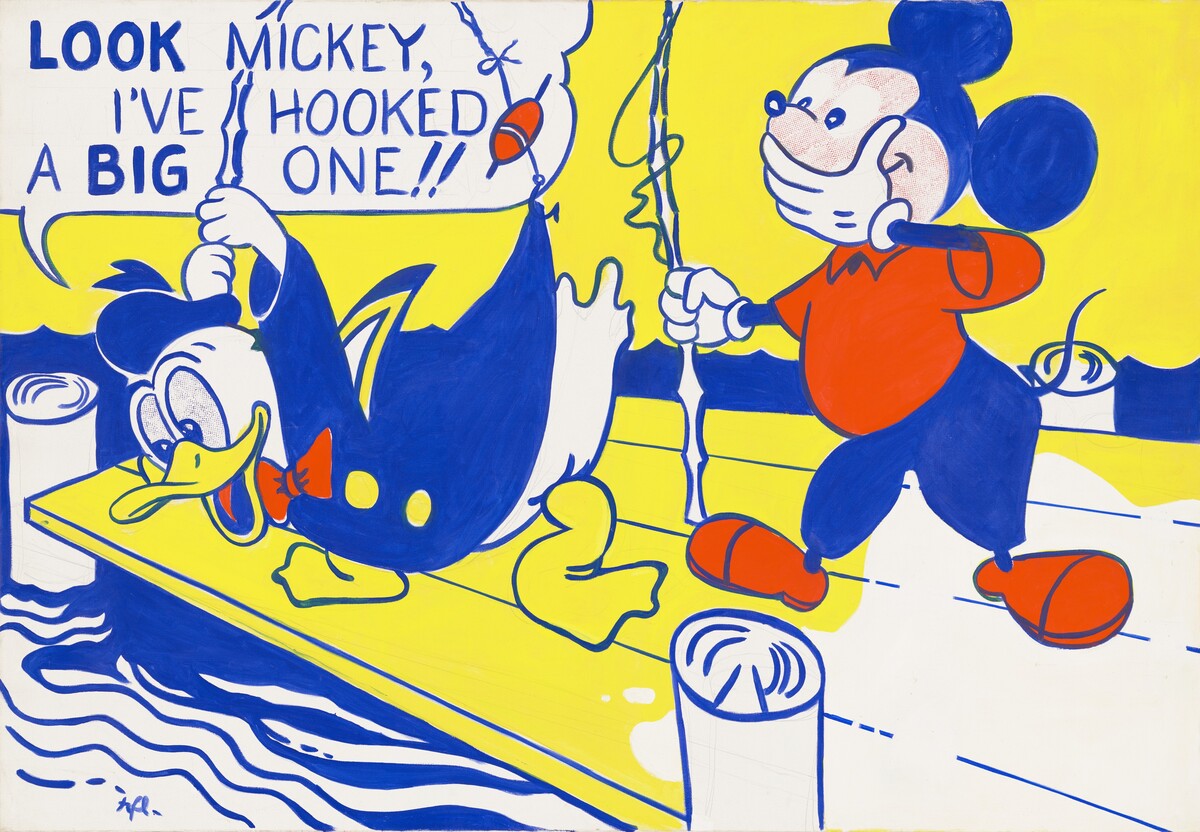
Look Mickey from 1961 is one of Roy Lichtenstein's earliest Pop Art paintings, depicting a scene from a Disney comic book in the Ben-Day dots and flat color manner that would become his signature style. The painting shows Donald Duck and Mickey Mouse in a fishing scene from a children's book, rendered at monumental scale in the comic-strip manner that Lichtenstein developed as a critique of Abstract Expressionism's insistence on personal expression. The 1961 date places this at the very beginning of Pop Art, when Lichtenstein was first developing the comic-strip manner that would make him one of the most recognizable artists of the 20th century.
Cultural Impact
Look Mickey is important in the history of 20th-century art because it is one of the first Pop Art paintings—among the earliest works in which Lichtenstein applied the comic-strip manner to high art. The painting's combination of popular imagery and monumental scale challenged Abstract Expressionism's monopoly on serious painting, and its Ben-Day dots and flat color established the manner that would define Pop Art and influence every subsequent development in late 20th-century art.
Why It Matters
Look Mickey is Pop Art's opening statement: Donald Duck and Mickey Mouse from a Disney comic rendered at monumental scale with Ben-Day dots and flat color, the manner that Lichtenstein developed in 1961 to challenge Abstract Expressionism's monopoly on serious painting. The painting is among the earliest works that defined Pop Art.