Provenance
Mary Hooper Warner, Boston, Mass. [born 1879 and died 1972 at the age of 93, according to obituary in the New York Times, October 14, 1972]; by descent to her son Roger Sherman Warner, Jr., Cambridge, Mass., and Washington. D.C, [this information comes from the purchase documents of the Brod Gallery, London, summarized in Nuveen description in curatorial file]. Brod Gallery, London, by 1980 [advertised in the Burlington Magazine, September 1980 as with the Brod Gallery]; sold to Nuveen, Chicago, 1986.
Accession Number
238272
Medium
Oil on panel
Dimensions
59.7 × 85.1 cm (23 1/2 × 33 1/2 in.); Framed: 83.2 × 107.3 × 7 cm (32 3/4 × 42 1/4 × 2 3/4 in.)
Classification
Painting
Credit Line
Gift of Nuveen
Background & Context
Background Story
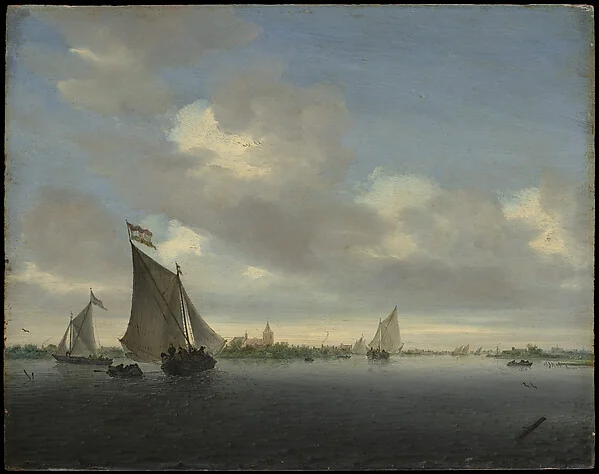
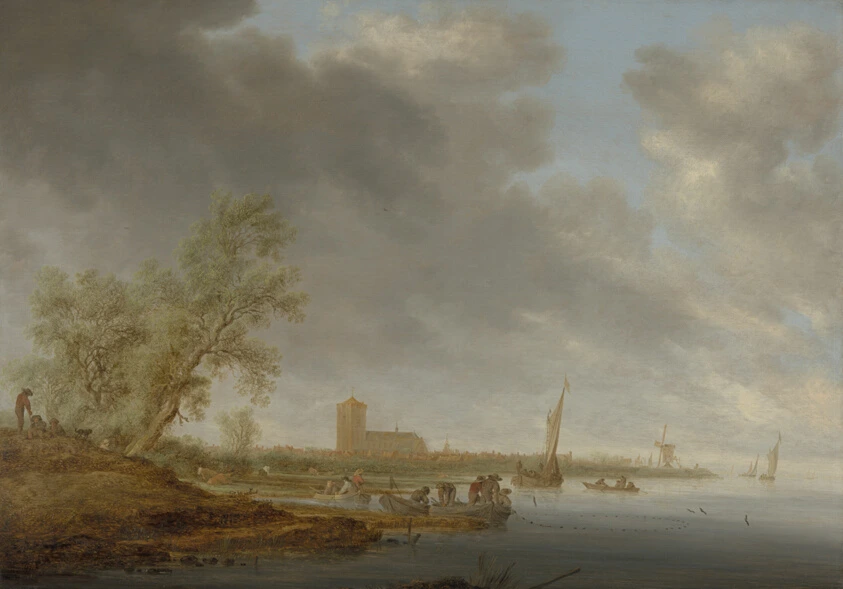
Salomon van Ruysdaels River Landscape with a View of Naarden from 1642 is an oil on panel painting that exemplifies the Dutch Golden Age masters approach to the river landscape, in which the flat topography of the Netherlands is transformed into a composition of extraordinary atmospheric subtlety and spatial depth. Naarden, a fortified town in the province of North Holland, provided van Ruysdael with a subject that combined the topographic specificity of a recognizable Dutch landscape with the compositional device of a river receding into the distance, creating a visual pathway that leads the viewer from the foreground of the composition to the distant horizon. Van Ruysdael, who was one of the most accomplished landscape painters of the Dutch Golden Age, developed a style in which the tonal values of sky, water, and land are organized into a coherent tonal progression from foreground to background, creating the illusion of atmospheric perspective that gives his river landscapes their characteristic sense of space and light. The boatmen and travelers who populate the river provide a narrative element that connects the landscape to the economic life of the Dutch Republic, in which river transport was the primary means of moving goods and people through a country defined by waterways. The oil on panel medium, with its capacity for fine detail and smooth tonal transitions, allows van Ruysdael to create the atmospheric effects that distinguish his best work, in which the sky and water are rendered with the same tonal subtlety that gives the landscape its sense of space and light.
Cultural Impact
Van Ruysdaels river landscapes are among the most accomplished works in the history of Dutch landscape painting, and their influence on the development of landscape painting extends from his contemporaries through the 18th century to the Barbizon School and the Impressionists. River Landscape with a View of Naarden demonstrates the atmospheric subtlety and tonal organization that make his work significant.
Why It Matters
A 1642 oil on panel painting by van Ruysdael of a river landscape with the fortified town of Naarden in the distance, combining topographic specificity with atmospheric subtlety and tonal organization that creates spatial depth in the flat Dutch landscape tradition.